
Máté Orr
On Ambiguity, Emotional Tension, and the Inner Logic of Images
A conversation with the Budapest-based painter on animals, vulnerability, theatricality, and the quiet force of complexity.
Nordrom Kunst is pleased to publish this conversation with Máté Orr, a painter whose works inhabit a space where emotional tension, ambiguity, and visual control coexist with striking intensity. Across his compositions, human figures and animals appear suspended in scenes that feel at once intimate and theatrical, familiar yet slightly disquieting. What emerges is a painterly world in which vulnerability is never reduced to weakness, and where symbolic clarity is deliberately held at a distance in favour of something more open, unstable, and psychologically resonant.
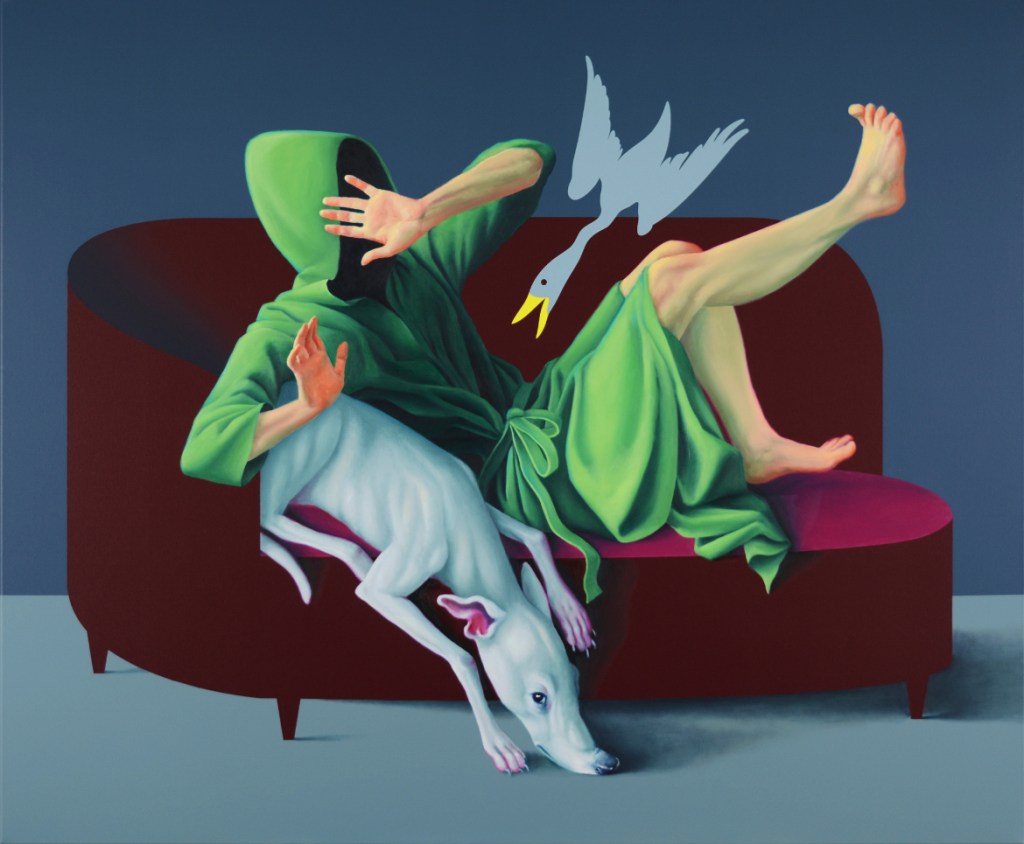
Based between Budapest and Sicily, Orr has developed a distinctive visual language in which structure and emotional uncertainty remain in constant negotiation. His paintings do not seek to resolve this tension. Instead, they give it form. Animals, recurring throughout his work, do not operate as fixed symbols, but as active presences within the internal logic of each image. They can soften, disturb, contradict, or complicate the scene. Their role shifts, as does the emotional charge they carry.
What makes Orr’s work particularly compelling is the seriousness of its visual language. Monumental in tone yet deeply attentive to fragility, his paintings bring weight to themes that have not always been granted such space: vulnerability, emotional exposure, shifting power relations, and the ambiguity of human experience. Rather than offering the viewer a narrative to decode, they open a threshold into states of mind that resist simplification.
In this conversation, Máté Orr reflects on the presence of animals in his paintings, the balance between control and unpredictability in his compositions, and his desire to create images that function like spaces of reflection, where uncertainty is not something to overcome, but something to remain with.
Nordrom Kunst
In many of your paintings animals appear alongside human figures almost as equal protagonists. When you begin a work, do these creatures emerge from intuition, symbolism, or from something more instinctive?
Máté Orr
My impression is that a lot of trauma originates from bad experiences with people, neglect or abuse by others. Yet as social beings, we crave connection. As Elisabeth Tova Bailey writes in The Sound of a Wild Snail Eating, “All humans experience isolation as torture.” Animals can offer a form of presence without the risk of repeating bad patterns. Dogs are especially great at this.
Animal depictions have always been a source of joy for me, in art, on clothing, in architecture. And it seems I am not alone. If someone passes the Porcellino in Florence, they feel compelled to touch it.
What I aim for in my work is not established symbolism, but what the animal brings into the internal logic of the image. Like in fables, they create a slight distance that allows difficult themes to be approached less cautiously.
Some animals recur, waterbirds, hares, domestic and wild cats, as well as crocodiles and dinosaur-like creatures. But their meaning is not fixed. The energy they carry shifts from one painting to another. Some associations are difficult to escape: no one reads a crocodile with sharp teeth as cuddly. Cats can appear both tender and predatory. Sometimes I deliberately show delicate waterbirds and fluffy hares in aggressive roles to contradict our assumptions.
In Orr’s reflections, animals emerge not as decorative additions or stable allegories, but as emotional and compositional agents. They introduce a delicate displacement into the scene, creating enough distance for more difficult psychic material to surface without becoming overdetermined. Their presence recalls the logic of fable, but stripped of moral closure. Instead, they inhabit the painting as unstable carriers of mood, contradiction, tenderness, and threat.
Nordrom Kunst
Your compositions feel extremely controlled, yet the situations often appear strange or slightly unsettling. How do you navigate the balance between structure and unpredictability when constructing an image?
Máté Orr
My work centres on moments of emotional tension: shifting control, fluid power relations. In recent decades, psychology has fundamentally shifted how we think about concepts like vulnerability, it is no longer seen merely as a weakness, but recognized as an integral aspect of human experience.
Also, from a young age my parents often took me to museums and churches to look at classical art. Much of what I saw was designed to be impactful and persuasive: from ancient Egyptian works that represented the power of the rulers to Baroque painting, which sought to captivate the faithful. I think these early experiences shaped my sensitivity to images that carry a sense of weight and authority.
What I try to do is to apply a serious, almost monumental visual language to everyday themes like vulnerability that have historically not always been treated as worthy of attention. In doing so, I hope to give these subjects the weight I believe they deserve.
This tension between monumentality and psychological instability is central to Orr’s practice. His paintings feel composed with precision, yet never fully settled. Their control does not eliminate unease; it heightens it. By drawing on the visual authority of historical painting while redirecting that authority toward states such as fragility, exposure, and emotional imbalance, Orr repositions vulnerability not as something marginal, but as a subject deserving gravity and scale.
Nordrom Kunst
If one of your paintings could function like a small theatre scene, what kind of story or emotional state would you hope the viewer might enter for a moment?
Máté Orr
This is very much on my mind at the moment as I am currently working with the Hungarian State Opera on a project where the world of my paintings serves as a starting point for the set and costume design.
Generally, I would like it if there would be greater acceptance of the fact that the world is complex. Evolution has taught us to conserve energy, and understanding complexity requires a lot of it. We like a shortcut and an easy answer to a difficult question. So what I want the viewer to enter is a state of mind in which the story is kind of ambiguous or even perplexing, but it is not experienced as a problem to solve. Instead, it is a space for reflection and awe, where uncertainty and complexity are not just allowed but can become compelling.
Perhaps this is where Orr’s paintings open most fully: not as images that ask to be solved, but as spaces in which ambiguity becomes generative. Their theatrical quality does not produce narrative certainty, but rather a heightened emotional atmosphere in which the viewer is invited to remain alert, suspended, and receptive. In this sense, the paintings do not simply depict complexity. They enact it.
For Nordrom Kunst, it is a pleasure to publish this conversation with an artist whose work insists on complexity without losing visual clarity, and whose paintings offer a rare balance of elegance, tension, and psychological depth. Máté Orr reminds us that ambiguity need not weaken the image. It can, instead, become the very condition of its force.
Works by Máté Orr are currently on view in Budapest in his solo exhibition The Boy Who Fell into the Fountain at am projects by Ani Molnár Gallery, on view from 3 April to 30 May 2026. His website also lists an upcoming group exhibition in Portland with Thinkspace x Antler & Talon Galleries in June 2026. Orr is based between Budapest and Sicily.
Painting capture: An Unperceived Threat Is Still A Threat 100×120 cm, oil and acrylic on canvas. 2024
Photo Credit: Máté Orr or Courtesy of the artist
 Nordrom Kunst