
Ingunn Skogholt
On Collage, Tapestry, and the Architecture of Inner Space
A conversation with the Norwegian artist on abstraction, tactile memory, weaving, and the slow construction of visual depth.
Nordrom Kunst is especially pleased to publish this conversation with Ingunn Skogholt, a Norwegian artist whose practice moves with remarkable sensitivity between collage and tapestry. For a project such as Nordrom Kunst, rooted in a dialogue with Nordic art and visual culture, it feels particularly meaningful to share the work of an artist whose language holds together material intelligence, abstraction, and a deeply felt sense of space.
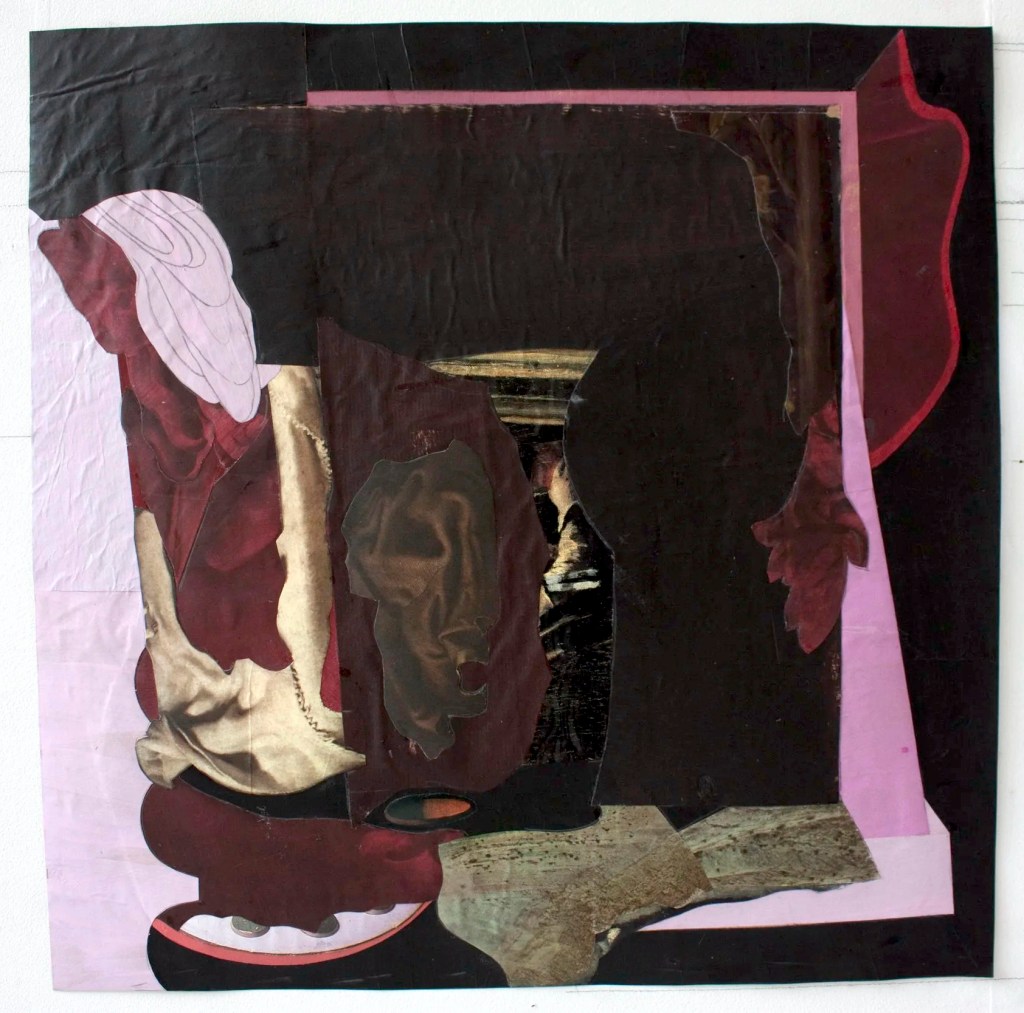
Skogholt’s works unfold through layers, fragments, colour fields, and tactile structures that seem to hover between inner landscape, architectural memory, and emotional composition. Whether on paper or in the loom, her images do not announce themselves through literal narration. Instead, they emerge gradually, through rhythm, proximity, contrast, and the quiet precision of materials handled over time. What becomes visible is a practice in which abstraction remains open, yet never vague; intuitive, yet carefully built.
A central aspect of Skogholt’s work lies in the relationship between collage and tapestry. Rather than existing as separate bodies of work, the two mediums appear in dialogue, each allowing something different to surface. The collages function both as autonomous works and as generative sites from which the woven pieces may later develop. In this passage from paper to textile, image becomes matter, and composition acquires a new physical and tactile force.
In this conversation, Ingunn Skogholt reflects on collage as an experimental space within her practice, on the emotional and spatial logic of abstraction, and on the way memory, movement, material choice, and visual rhythm come together in her work.
Nordrom Kunst
In several texts on your website, collage appears as an intuitive and experimental space within your practice, sometimes even as a pause or a break between larger tapestry works. How do these abstract collages help you think differently, and what can happen there that would not happen in weaving?
Ingunn Skogholt
My working process is often divided into several stages. The experimental part of my work is tried out on paper. I often have longer periods where I only work with collages. The collage works are the fundament and the guide to all my tapestry work. I also consider the collages to be their own pieces of work.
From this work process I find a collage that I want to develop further in the loom. Once that is decided the focus is on the materials and the dying of different yarn qualities. I weave mostly with cotton, linen, and some synthetic thread. I dye a lot of the material myself with industrial dyes to achieve a good lightfastness.
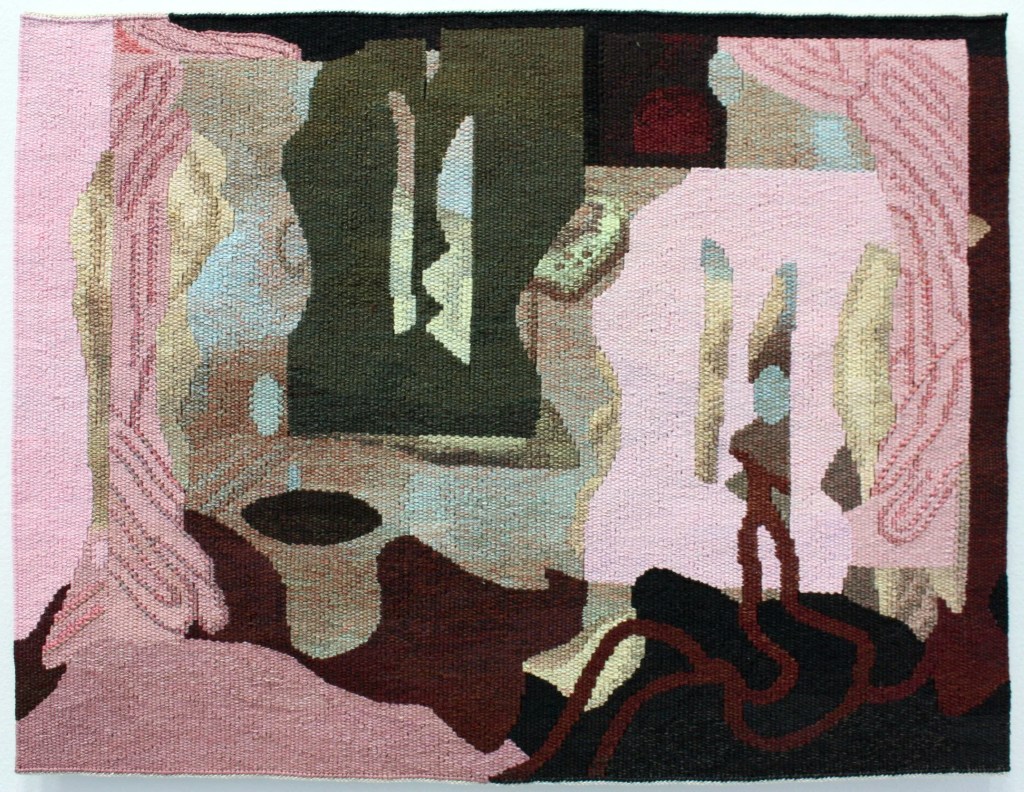
What happens in the weaving process is based on the composition and color combinations in the collage. I use a projector to draw the main lines from the collages as a guide. The warp is like a blank canvas where I slowly begin building the images or collages. The density of the warp threads varies depending on the details in the composition. The materials and the threads give a powerful and tactile expression that I seek and that I cannot express on paper.
Hannah Ryggen has been a great inspiration for my tapestry works since I was 15 years old. Since that time I wanted to be a tapestry weaver.
What emerges clearly in Skogholt’s reflection is that collage is not merely preparatory, nor simply a place of interruption between larger works. It is an active and necessary field of experimentation, one in which composition, colour, and movement can first be discovered. Yet it is in the transition to tapestry that the image acquires density, tactility, and resistance. The woven surface does not reproduce the collage. It transforms it, allowing the work to enter a slower and more physical register of presence.
Nordrom Kunst
Your collages seem to build a delicate balance between fragments, layers, movement and colour, often creating a strong sense of spatial depth. When you begin an abstract composition, are you guided more by rhythm, by colour relationships, or by the feeling that the image should hold emotionally?
Ingunn Skogholt
The works often take on their own rhythm that I cannot on beforehand decide but that I discover as I work. The process of working with the collages are separate from my work in the loom. A color combination is often a starting point to develop further. I use the studio floor as a working table and paint large areas of different colors. I also have a large store of paper cuttings from earlier collage works. The images are often from earlier paper works, from photographs, or from magazines and newspapers. I do work on several parallel ideas which often end up as one piece of work.
In my studio I have a mezzanine above the ground floor. From this distance I can control or alter the elements and paper clippings which are placed on the various background colors. In this way I use the distance to make the images find the right place in the composition. I enter the composition in my mind searching for a movement and a feeling of space. I have strong visual memories from my walks in nature and my outdoor time. I transform organic forms looking for ways to abstract them into my compositions.
In architecture I find undiscovered rooms and the perspective that often also come as inspiration. Maybe the combination of some of these themes can describe in words what I try to express visually. The artist Kurt Schwitters has inspired my collage works for several years.
This description offers a rare insight into an abstract practice grounded not in pure formalism, but in embodied looking. Skogholt’s compositions seem to arise through a negotiation between distance and intimacy, intuition and adjustment. Her references to nature, architecture, memory, and found fragments do not resolve into a fixed symbolic system. Instead, they become part of a spatial and emotional search. One senses in these works not only the construction of an image, but the patient formation of an atmosphere.
Nordrom Kunst
We were very interested in the poetic and slightly puzzling atmosphere that runs through works such as Bånd II, Eternally folded, Gjennomgående and other recent collages. How do you understand abstraction in your work: as a language of memory, material sensitivity, inner landscape, or as something that should remain open and unresolved for the viewer?
Ingunn Skogholt
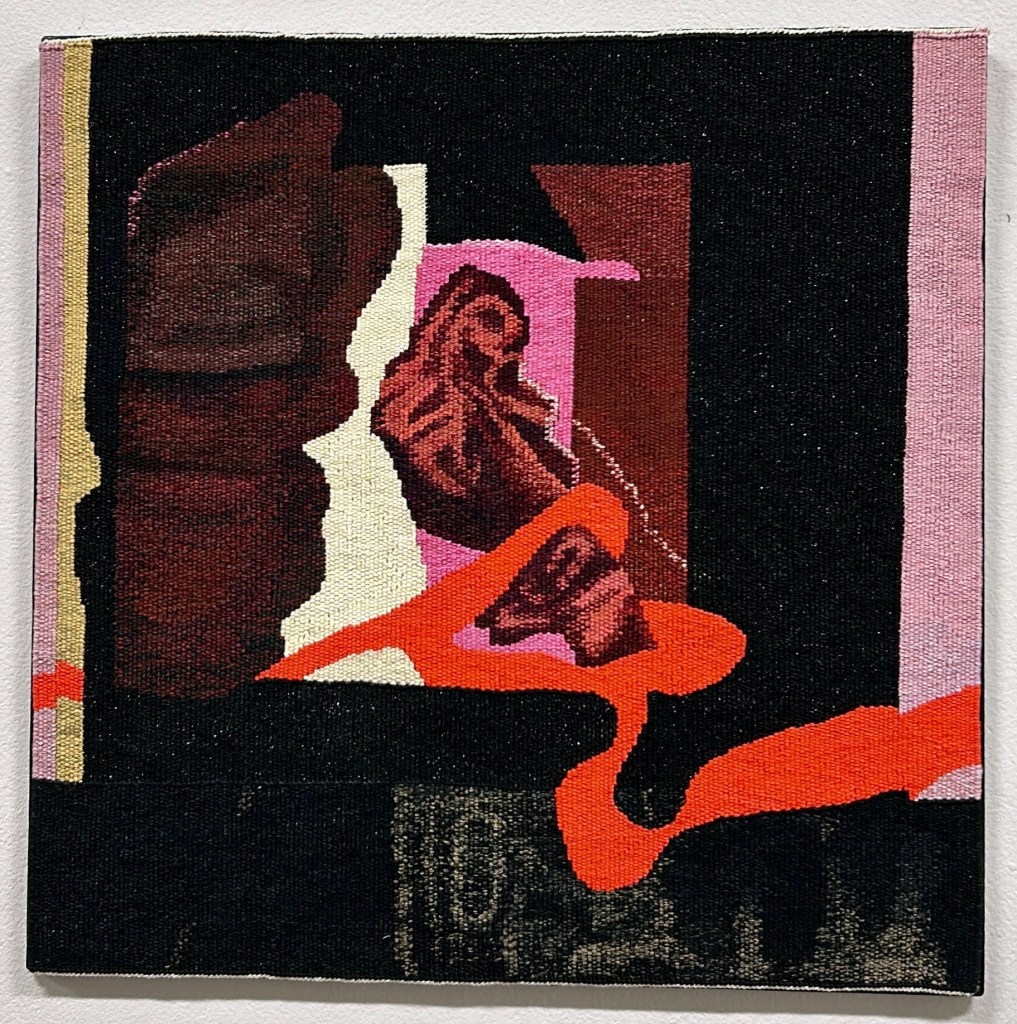
The tapestry Bånd II was part of an exhibition at Kunstnerforbundet in Oslo in 2022. The exhibition of tapestry work in larger and smaller scale were all connected in various combinations of pink and contrasting darker colors. I was playing with floating lines on top of the surface, based on the background of one of my old photographs, mostly present in the tapestry Bånd I that you can view on my website. The title Bånd in Norwegian has a dual meaning, bånd as in ribbon, and bånd as a connection between people.
The collage Eternally folded has never been developed as a tapestry. It is the result of a longer period of collage work for the exhibition at Kunstnerforbundet. The elements of various images of materials turn into new and unknown lines which create an inner room framed with a contrasting pink. I can describe it as an inner landscape and a tactile memory.
The tapestry Gjennomgående has a contrasting element that runs through the image and gives it its title. Choosing materials is an important part of my weaving practice; the choice of quality, the feeling of the threads, and the various structures. I use a lot of mercerized cotton which dyes beautifully and has an attractive quality to work with. I spend a lot of time considering the colors and the nuances of colors to have a large palette to work from. In Gjennomgående I decided on a shiny synthetic thread wanting to achieve an especially shiny and black surface.
I always aim to achieve a solidity and quality in my finished work.
Skogholt’s answer suggests that abstraction, in her case, does not belong to a single interpretive category. It moves between memory, structure, tactility, and emotional resonance without ever closing into one stable meaning. A title may carry several associations at once. A colour may frame an inner space. A thread may alter the entire surface through sheen, density, or resistance. What gives these works their force is precisely this ability to remain open while still feeling exact. They do not dissolve into vagueness. They hold.
For Nordrom Kunst, it is a particular pleasure to publish this conversation with Ingunn Skogholt as part of our growing dialogue with artists whose practices resonate strongly with the Nordic and Northern sensibility at the core of the project. Her works remind us that abstraction can be both rigorous and poetic, and that material sensitivity can become a way of thinking as much as a way of making.
Selected images (artist photo credits) accompanying this interview include both collage and tapestry works that reflect the artist’s distinctive balance of depth, structure, softness, and spatial ambiguity. To discover more of Ingunn Skogholt’s work, visit her website at ingunnskogholt.no and follow her on Instagram at @ingunnskogholtart.
 Nordrom Kunst