
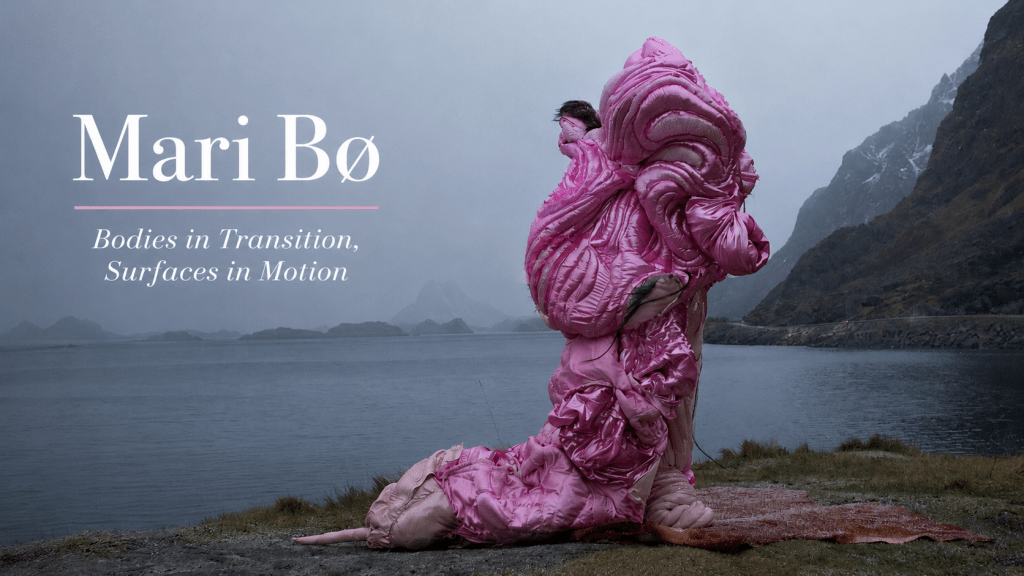
Bodies in Transition, Surfaces in Motion
Performance, weaving, movement, sound and materiality all coexist within the practice of Mari Bø. Moving between choreography, installation, textile based processes and performative environments, her work explores how bodies are constantly perceived, interpreted and negotiated through social, physical and emotional structures.
In projects such as Surfacing, ERROR:gender and ENE, the body becomes not only a physical presence, but also a surface of projection, vulnerability, transformation and collective interaction. Through movement, texture and spatial experience, Mari Bø investigates how identity, gender, motherhood and belonging can shift, dissolve and reappear through artistic practice.
For Nordrom Kunst, we spoke with the artist about performance, bodily perception, weaving, public interaction and the evolving relationship between body and material research.
Nordrom Kunst:
Your practice moves between dance, performance, visual art, sound and texture. How do you understand the body as a material, a surface and a space of artistic research?
Mari Bø:
Coming from a background in dance, my practice very early on had a close connection to the body. For me, this connection was physical. I am physically moving my body in various ways, but it was also conceptual. In one of my early performances, I was exploring listening as a concept, how the way you listen to music impacts the way you move your body, and what that looks like on a dance floor.
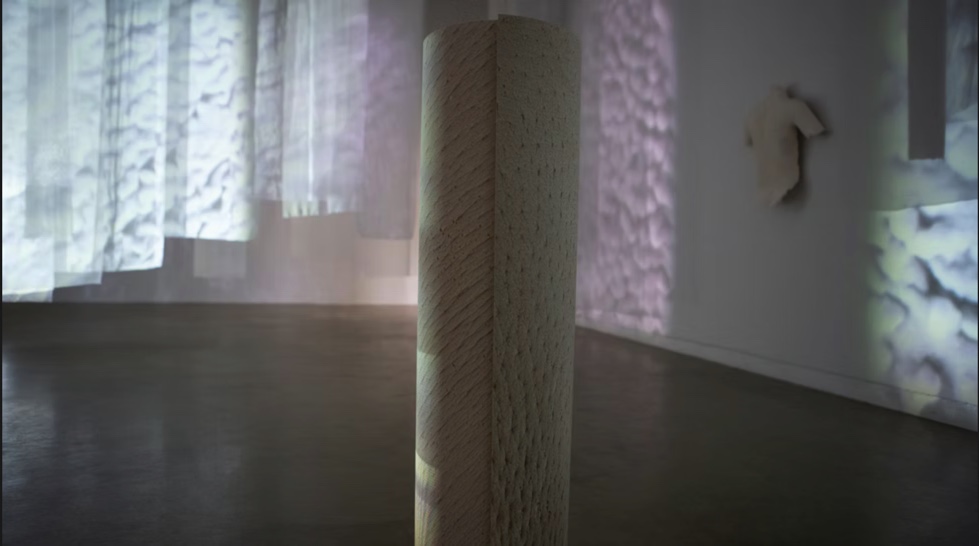
Installation view, mixed media
Photo by Leifur Wilberg Orrason
Courtesy of the artist.
When I did my MA in Fine Art, I became more aware that my own body did not always have to be present in the space, while at the same time I started using it more consciously as a material for exploration.
But bodies can also become fixed in terms of what stories they can tell. When you see a body outside on the street, you are often very quick to determine aspects such as gender, age and ethnicity, and then the mind usually follows with assumptions about how this body speaks, how it moves and what kind of life it lives. These assumptions are difficult to escape when working with the body as a medium. You quickly fall into ideas of who this body belongs to.
In a previous project, Surfacing (2020), I tried exploring my own surfaces in different ways through casting, photography and electron microscopy. Throughout my MA, my investigation became, in a way, an attempt to see my own body differently and to see it become something else.
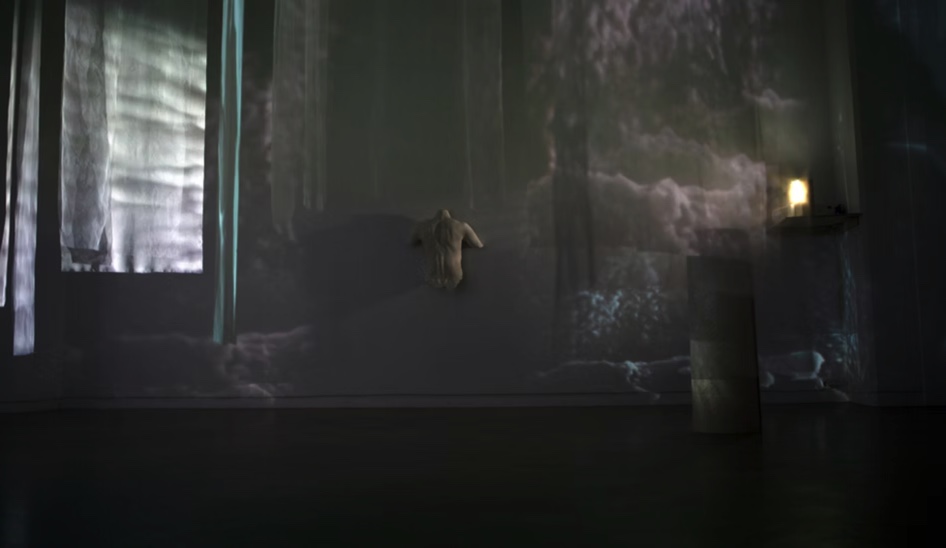
Installation view, mixed media
Photo by Mari Bø
Courtesy of the artist.
Since becoming a mother in 2021, the body has also taken on other meanings through practical, relational and emotional changes that I had not fully anticipated. It left me very preoccupied with the idea of being stuck, stuck in assumptions and expectations that felt all encompassing. I made several performances around this, exploring different ways of being and feeling stuck.
Over the last five years, I have been exploring weaving, working mostly with inkle loom and heddle loom. I have combined this practice with performance in different formats, and I find the combination of using my body to make something, and then later performing with my body in relation to that same material, very interesting.
Working with my own body as the starting point of my investigations allows me not only to understand myself better, but also becomes a way of thinking through how bodies are shaped by and exist within material, social and spatial structures.
Nordrom Kunst:
In projects such as Surfacing, ERROR:gender and ENE, the body seems to become a place where identity, gender, perception and social norms are questioned. Is there one project that you feel represents this investigation in a particularly important way?
Mari Bø:
ENE (2025–2026) is a very interesting exploration of the body for me, perhaps also because it is quite recent, so it is closely connected to what my practice is currently exploring.
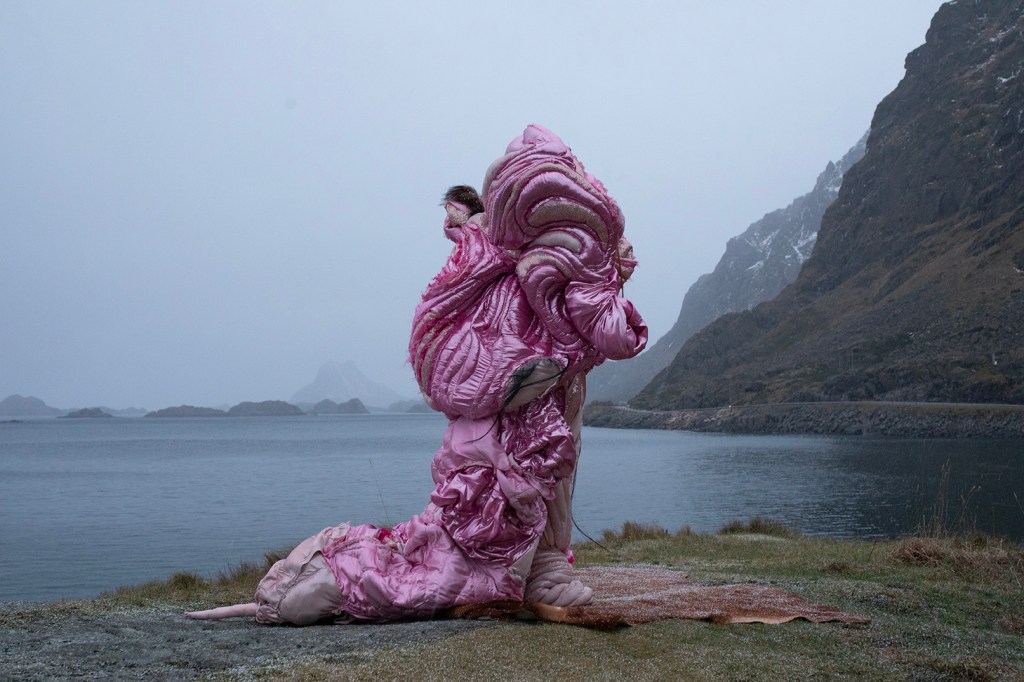
Performance
Photo by Ingrid Eggen
Courtesy of the artist.
ENE is a collaborative project with, among others, costume designer Solveig Holthe Bygdnes, where I am inside a large costume and textile sculpture and move around during the performance while a sound piece is played from speakers within the sculpture.
I find it particularly interesting because it allows me to change my own form in relation to the outside world. It almost allows me to be someone else, or to wear a different body in public space. This new body becomes the subject of a physical exploration of what a body can be.
By keeping some organic elements such as sound and movement, the project allows me to explore other facets of the body. Where is the head? What is it feeling? Where does this body come from? What can it be?
Sometimes this exploration happens together with the audience, depending on the level of interactivity and the age of the audience. We recently had a performance become an exploration of how different bodies negotiate consent, with younger audiences exploring how and when to reach out to the sculpture and performer in careful ways.
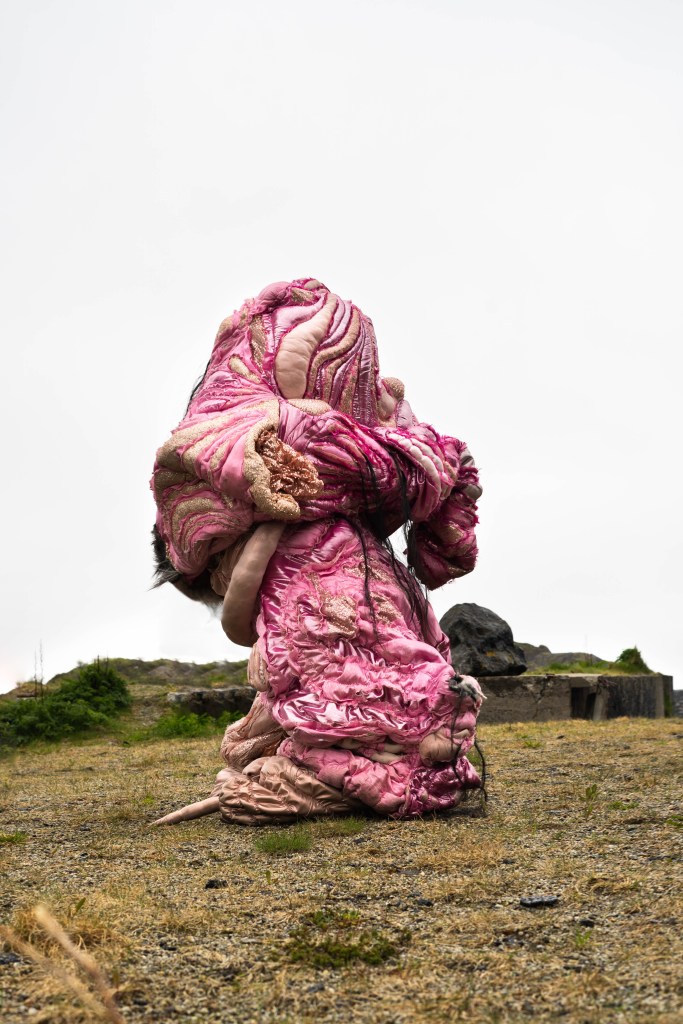
Performance
Photo by Varvara Stojan
Courtesy of the artist.
Other times, it becomes a more internal process, where I explore what stories this new body can tell when it no longer resembles my own. For me, it is also very much an exploration of the line between beauty and disgust, and I enjoy how differently each audience member experiences the performance.
ERROR:gender (2021–2025) is in many ways very different from ENE, but both are connected in my practice through the exploration of bodies and gender. In ENE this exploration is never explicitly stated. It is more implicit. In ERROR:gender, the whole concept is to generate dialogue between people on topics that might be difficult to talk about.
The project is a social and conceptual installation consisting of up to 17 performers who each contribute with their own practice. Each performer has some thematic connection through exploring bodies, gender or sexuality, while using different artistic strategies.
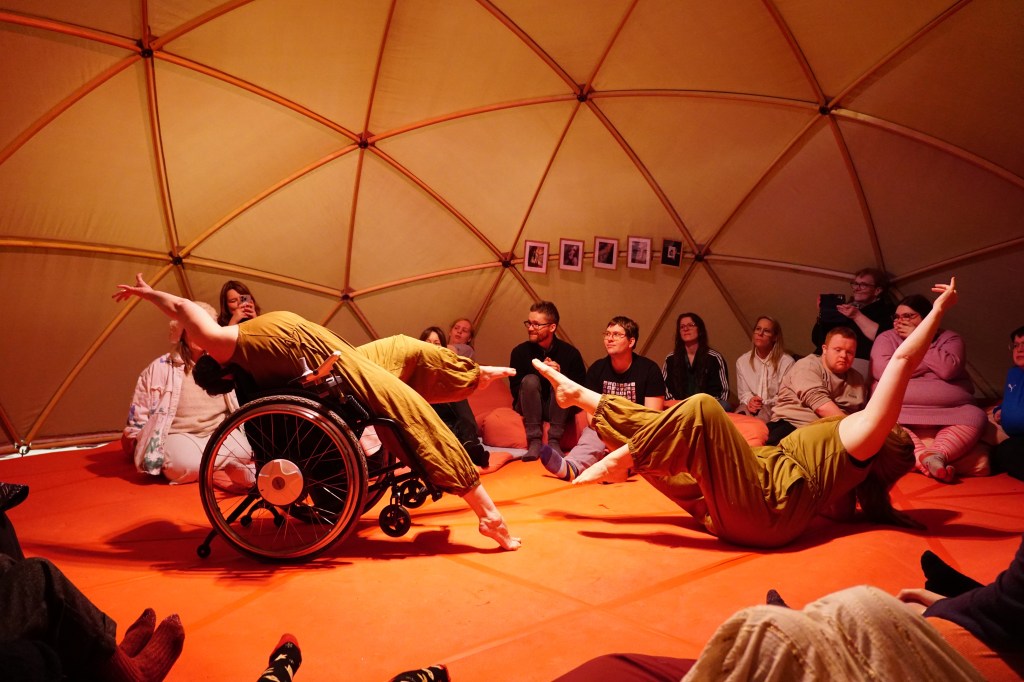
Collaborative installation
Photo by Åsne Storli
Performers: Embla Guðrúnar Ágústsdóttir and Íris Stefanía Skúladóttir
Courtesy of the artist.
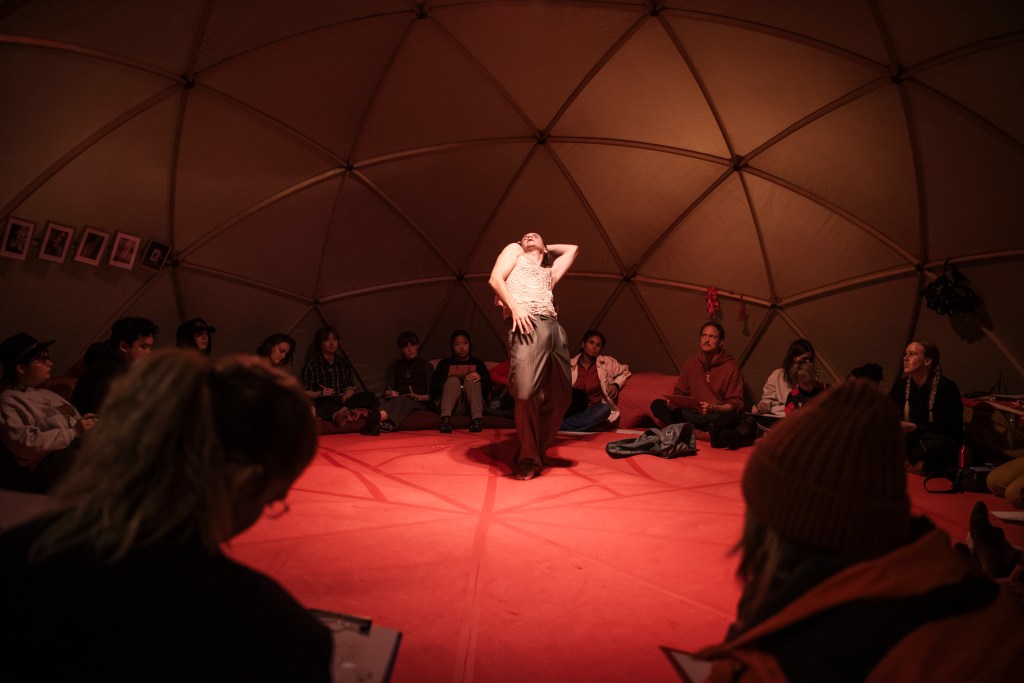
Collaborative installation
Photo by Odysseas Chloridis
Jérémy Gaudibert performance workshop, Contour2
Courtesy of the artist.
With ERROR:gender, I enjoy the fact that everything is spoken out loud, and that we use art as a way to bridge gaps in conversations around bodies, gender, pleasure and belonging.
I think it is important to create spaces for these conversations, especially in public contexts and between people who might not agree. In the project, we are not trying to force a single perspective, but rather to bring different voices together and let them coexist peacefully.
Nordrom Kunst:
Are you currently working on any new projects, exhibitions, performances, research or future plans that you would like to share with Nordrom Kunst readers? And are there any new artistic directions or questions that you are developing at the moment?
Mari Bø:
I am currently working on a new project called Kroppsvev – Kehokudos. It is an interdisciplinary project where weaving is at the centre, and where I use concepts and textures from weaving as a starting point for creating and choreographing movement.
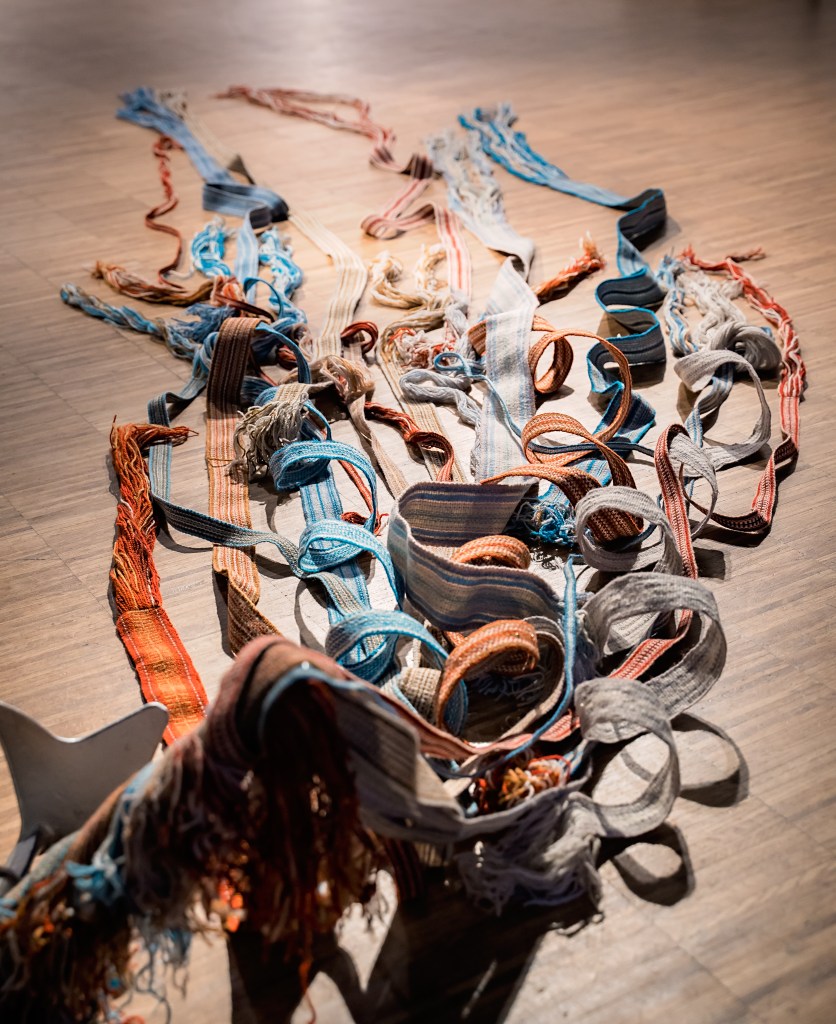
Woven bands and anchor, from the performance Mii Leat // Mii Gávdnot
Collaboration with Bárrogiera Dance Company
Photo by Freydis Fotograf and Myriam Marti Fotografi
Courtesy of the artist
I enjoy working in collaborative processes, and this project brings together artists from different disciplines.
Working across performance and textile based practices, I am always interested in exploring how these two fields can intertwine. With Kroppsvev – Kehokudos I can go deeper into that relationship.
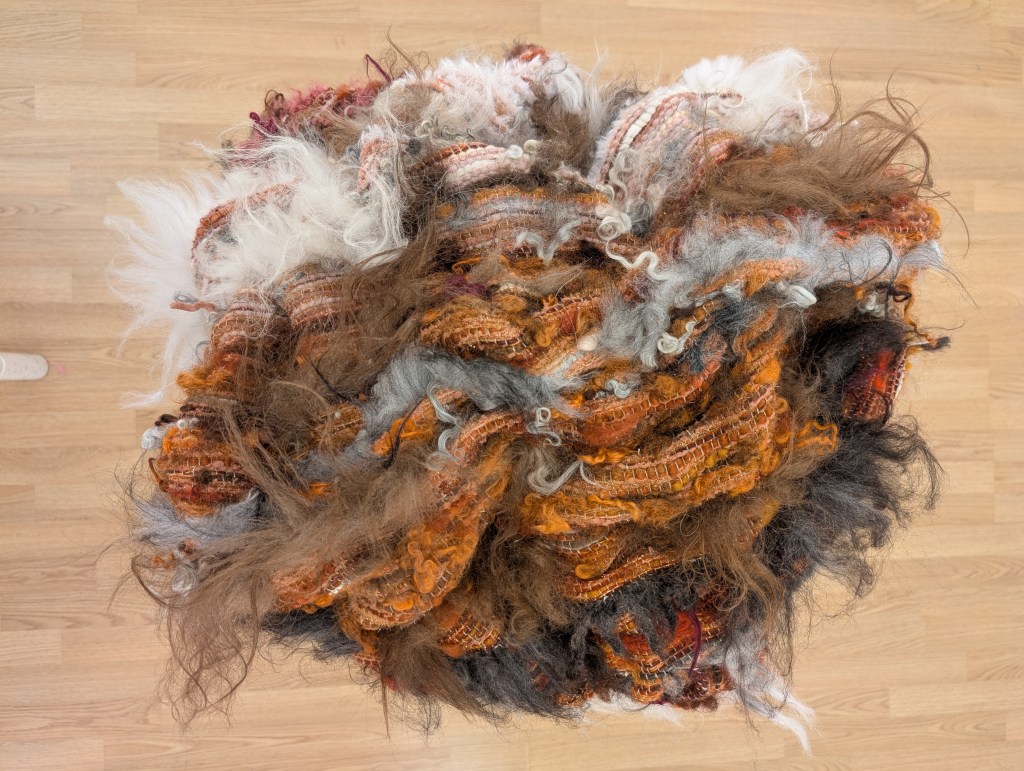
Handwoven textile exploration
Courtesy of the artist
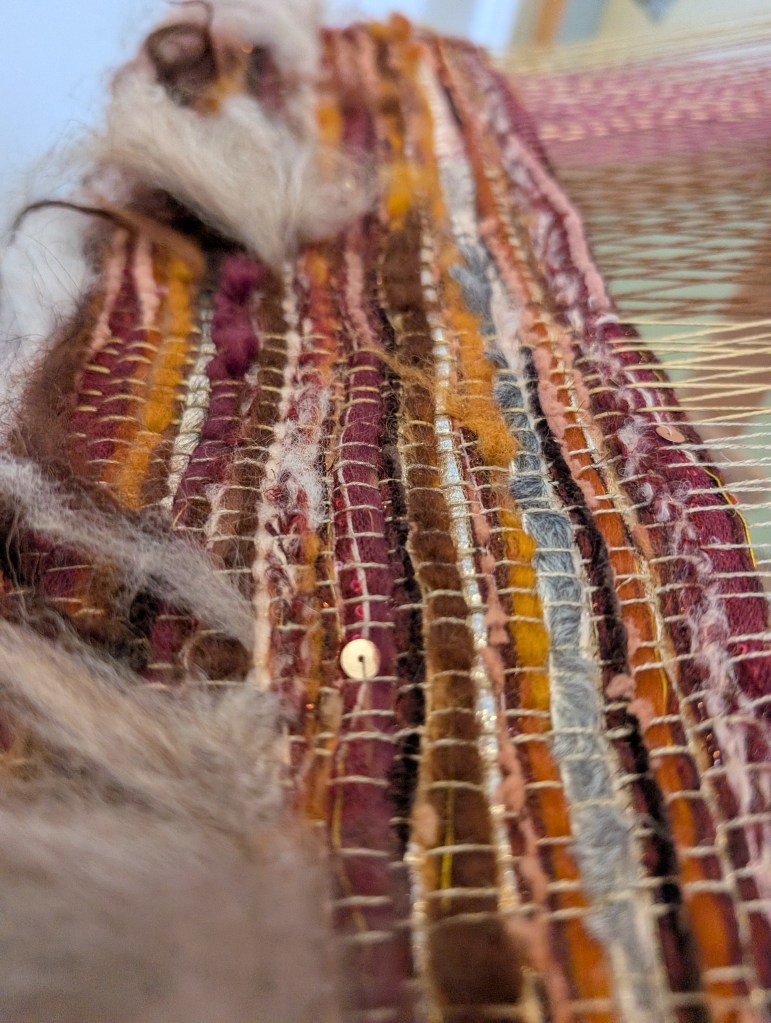
Inkle loom and heddle loom exploration
Courtesy of the artist
The project uses weaving, movement, sound and text to explore matrescence, the transformation of becoming a mother. The concept can in many ways be compared to adolescence, as it involves bodily, practical, emotional and relational changes, and it is specifically connected to parenthood.
I am interested in how both motherhood and the concept of matrescence are generally understood as specifically gendered. I experience bodies and identities as more fluid than fixed, yet becoming a parent has felt strongly gendered in ways that have at times left me feeling somewhat lost. I am curious about how these transitions might be understood in more open ways.
For me, becoming a parent was overwhelming, intense, beautiful and also destabilising. It feels strange that this is such a common experience, yet something we do not speak about more openly.
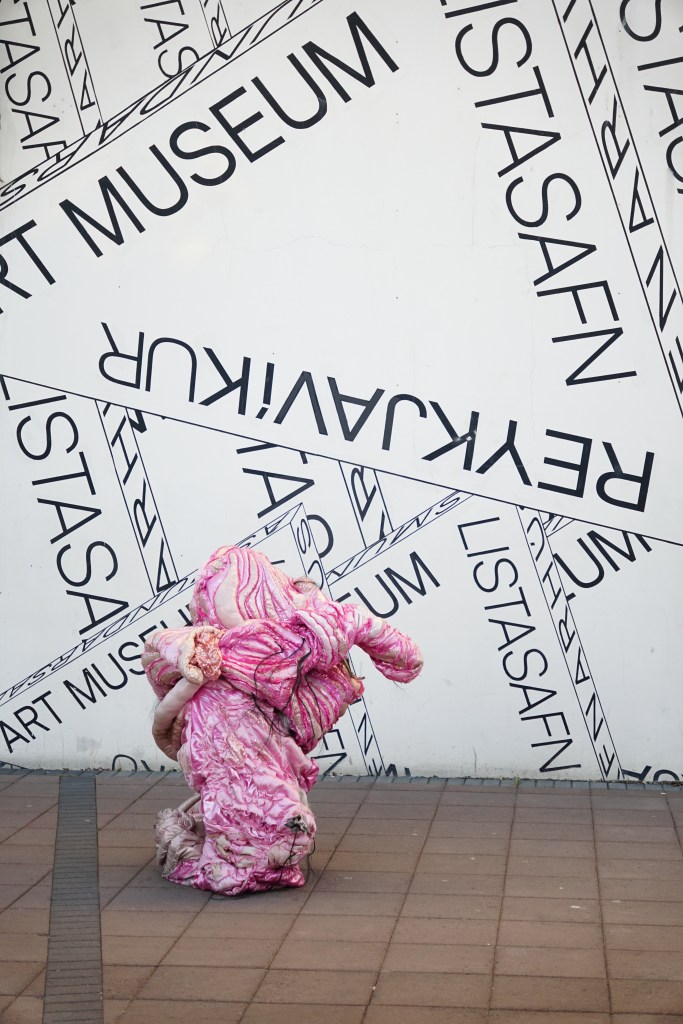
Performance
Photo by Åsne Storli
Courtesy of the artist.
These reflections also connect back to weaving. Growing up, there was always some form of knitting, weaving or handcraft in my surroundings. It was a quiet, everyday practice, present but not always articulated as the care and attention that it held.
I have started to see connections between weaving and caregiving. Both are repetitive, often invisible forms of labour, built through attention, maintenance and small daily actions.
I am interested in weaving not only as a material practice, but as a durational one. The repetitive actions, the slowness and the physical labour all mirror aspects of both performance and caregiving, where understanding often emerges through repetition rather than through planning.
Weaving becomes a way of exploring belonging, both in a personal sense and in relation to something inherited or carried over time. I connect it to my heritage, and explore whether there are traces of this in me, in my movements and in my work.
Across my work, I keep returning to the body as something that is both very personal and very exposed, something that is constantly being read, shaped and negotiated. Whether I work with performance, textile or installation, I am interested in creating situations where the body can shift, or be seen differently, even if just for a moment.
Movement is always at the centre of what I do, and this constant shifting keeps me engaged.
Find out more information about Mari Bø on her website mari-bo.com
 Nordrom Kunst