
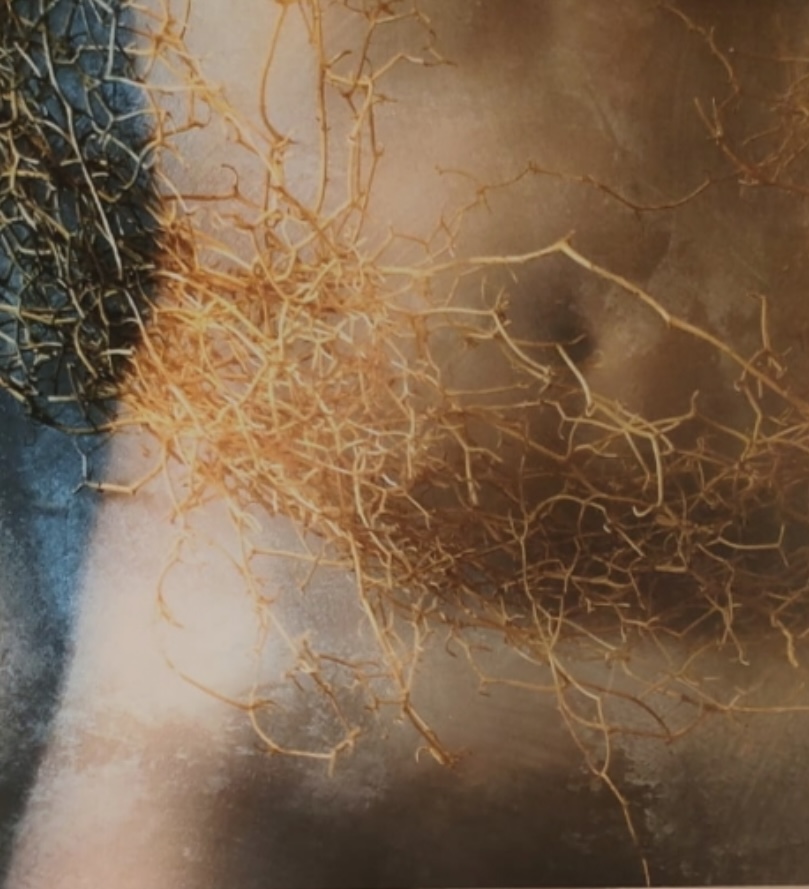
In dialogue with the exhibition STRATI/LAYERS at Spazio Eughen in Rome, Paola Tornambé’s photographic work moves through long exposure, movement, memory and the dissolution of the image.
Nordrom Kunst was born from a strong interest in Northern Norway, Scandinavia and Arctic landscapes, but its editorial geography is not confined to one territory. The project also develops through a network of cities with which Fabio Lanna, founder of Nordrom Kunst, has built personal, biographical and curatorial connections over time: Rome, Budapest, Berlin, Amsterdam, Vienna and Reykjavík.
Within this map, Rome represents one of the project’s essential points of contact. It is a city where memory, matter, time and contemporary artistic research continue to overlap, generating dialogues that resonate deeply with the sensibility of Nordrom Kunst.
The exhibition STRATI/LAYERS, on view at Spazio Eughen in Rome until 17 May 2026, offers one of these possible dialogues. In this context, Paola Tornambé’s photography enters into conversation with the material and layered sculptures of Eughen, the artist who lived, worked and shaped that space throughout his life.
Paola Tornambé’s photographic work does not simply stop an image. Through long exposure and movement, her photographs become deposits of time: surfaces where figures, inner landscapes and emotional traces emerge, dissolve and remain suspended. Her research inhabits a threshold between visible and invisible, presence and dissolution, memory and transformation.
In this interview, Paola Tornambé speaks about her relationship with Spazio Eughen, the dialogue with Eughen’s work, her artistic obsession with time, and her desire to develop, in the future, photographic research connected to Northern landscapes, from the light of the Baltic Sea to Norway, the Lofoten Islands and Iceland.
Nordrom Kunst:
The exhibition STRATI at Spazio Eughen places your photography in dialogue with a strongly material and stratified environment. How has this space influenced the reading of your works and the way the public can move through them?
Paola Tornambé:
I loved Spazio Eughen from the very first moment I entered it to meet Lucilla, the daughter of the artist who worked there all his life and who now manages the space. It is such a particular place that it is not easy to contain it within a single definition. But it is certainly a place of love.
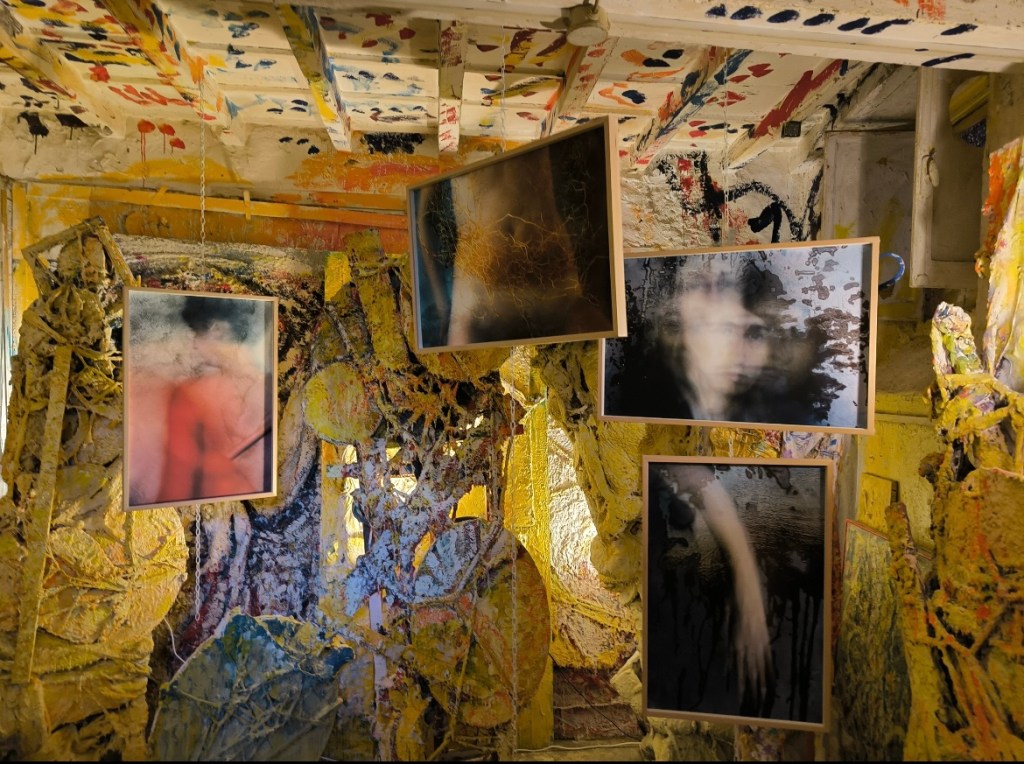
Eughen’s sculptures are born from time: he used recovered materials, which he assembled, and the result is a body of material, stratified works in which it is not only the outer layer that makes the work, but all the layers of which it is composed, added one after another.
In the same way, my photographs are composed of layers: I use a long exposure time combined with movement in front of the camera, and this allows me to obtain images with parts that emerge on the surface and others that are more blurred, appearing in transparency. They are works that can be brought close to a pictorial dimension.
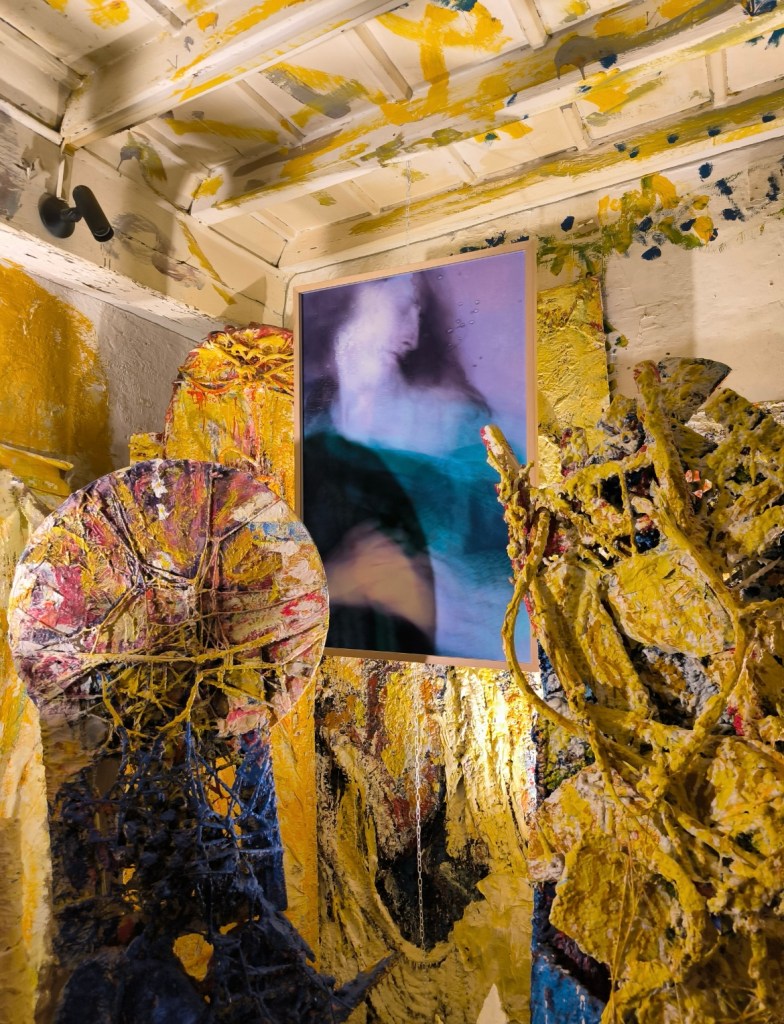
The dialogue with Eughen’s works was immediate and so natural that it became illuminating, starting precisely from the concept of layers and accumulated time. Visually, they come together through textures and colours, but it is above all conceptually that the magic of their dialogue takes place: both are an accumulation of time brought back to memory by the work itself, while standing on the edge of a further transformation.
They remind us that everything is unstable, and yet everything leaves a trace.
The space itself, in my view, is also a stratified place: after having been Eughen’s atelier, it is now a suggestive exhibition space open to other artists, but the soul of the painter remains clearly visible and concrete, transformed into a new form that contains it.
I believe that the dialogue between his sculptures and my photographs strengthens both: the sculptures make material and tangible the idea of passing through time expressed by my long-exposure images; in return, the photographs give the sculptures a figurative plane in which the viewer can more easily identify themselves.
What emerges is a slow passage through time, to be experienced in each transition and without haste, revealing layer after layer what has been.
Nordrom Kunst:
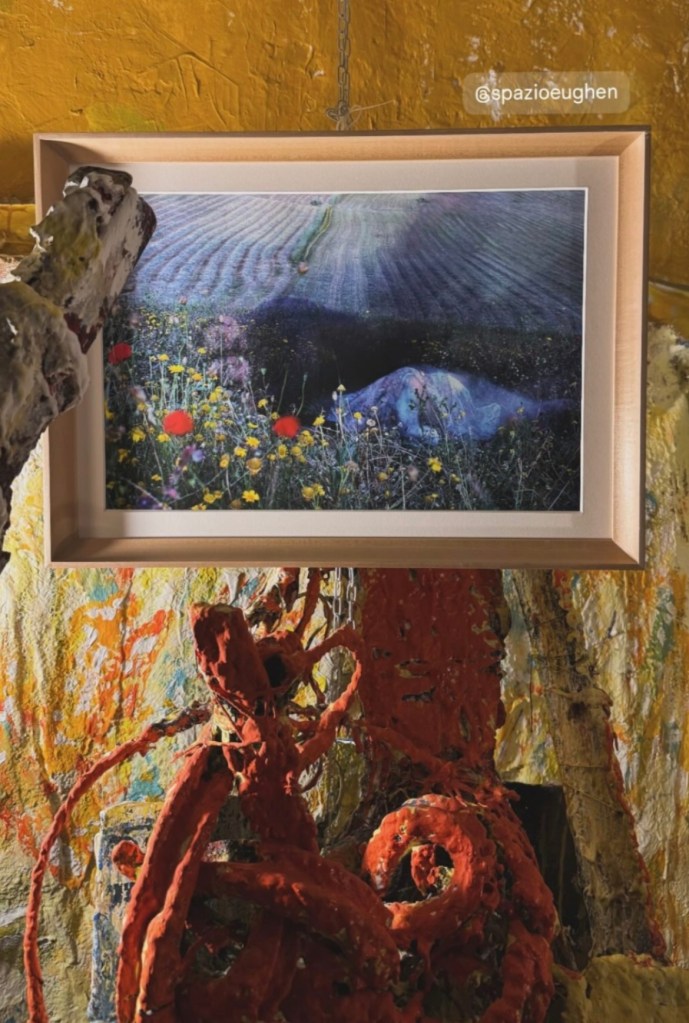
Your photography often seems to approach painting, not only visually, but also through time, superimposition, fading and the memory of the image. How did this way of working begin, and what role do slowness and stratification play in your photographic process?
Paola Tornambé:
My artistic obsession is to tell time. For me, it is exactly the opposite of the common idea: photography is not about stopping the instant, but about showing its flow.
Everything is unstable and yet everything remains, as I said before, and it is in this way that, through the combination of long exposure and movement, my images are composed of pictorial layers that concentrate the passing of time and whose purpose is to reveal an “other” reality.
They are situated in a border territory between visible and invisible, between presence and its dissolution, between memory and transformation, between depth and visual surface.
They are made of time that settles; they are constructed through accumulation and subtraction, retaining traces of what has happened, recording what escapes reality and continuing to change.
This way of working comes from intuition: a landscape, a natural element, a background suddenly calls me to the perception of something beyond. Through movement, which is the key to everything, and within the passing of time, I try to reveal this dimension.
It is something deeper that my photographs make visible, bringing a new meaning through slowness and stratification: for me, they are the key to accessing this higher reality.
This reality shows dreams, disturbances, sudden and revealing sensations, light and fleeting emotions, the deep dimensions of a restless soul and its imagination, the essence of the living magic of interiority, memories blurred into a hint of light.
Nordrom Kunst:
Nordrom Kunst was also born from a strong interest in Nordic and Arctic landscapes, understood not only as geographical places, but as fragile, silent, extreme territories deeply connected to the perception of light and environment. Would you be interested, in the future, in developing a photographic project or visual research connected to these natural landscapes and their environmental dimension?
Paola Tornambé:
First of all, I would like to thank you for giving me the opportunity to be present on Nordrom Kunst, even though I do not geographically belong to these territories. I am flattered by the association of my art with Nordic art.
I love nature, which is the first source of my artistic inspiration, and I love travelling very much. I am attracted to boundless and solitary landscapes.
So far, the northernmost place I have visited is the pier in Sopot, near Gdańsk, in Poland. I was there this winter, and the silence of the Baltic Sea, its vastness in front of me, moved me and opened my soul. It gave me breath.
Next December I will take another step north by visiting Tallinn, again on the Baltic Sea. I am in love with that light, with that perception of infinity, possibility, rarefaction, air, and extremity.
So yes, absolutely, it would be wonderful to visit Norway, the Lofoten Islands, and then also Iceland. Even more so, it would be beautiful to set a photographic work there.
Thank you for your interesting questions, and for this last one, which made me dream and brought me, even just for a moment in thought, to these wonderful places.
More information about the artphotographer:
Spazio Eughen can be found on instagram: @spazioeughen, located in one of the most beautiful quarters of the city in the historic Trastevere area in Rome at Vicolo del Bologna 36.
Images courtesy of the artist. The photographs document Paola Tornambé’s works installed inside the exhibition STRATI at Spazio Eughen, Rome, and are published with the artist’s permission.
 Nordrom Kunst
Lascia un commento