
Water, Light and the Memory of Landscape
In conversation with Nordrom Kunst, the artist reflects on water, shadow, memory and the emotional geography of the West coast of Norway.
Nordrom Kunst first encountered the work of Kristin Holm Dybvig through a quiet but immediate visual intensity: landscapes that seem to belong both to the outer world and to the inner one.
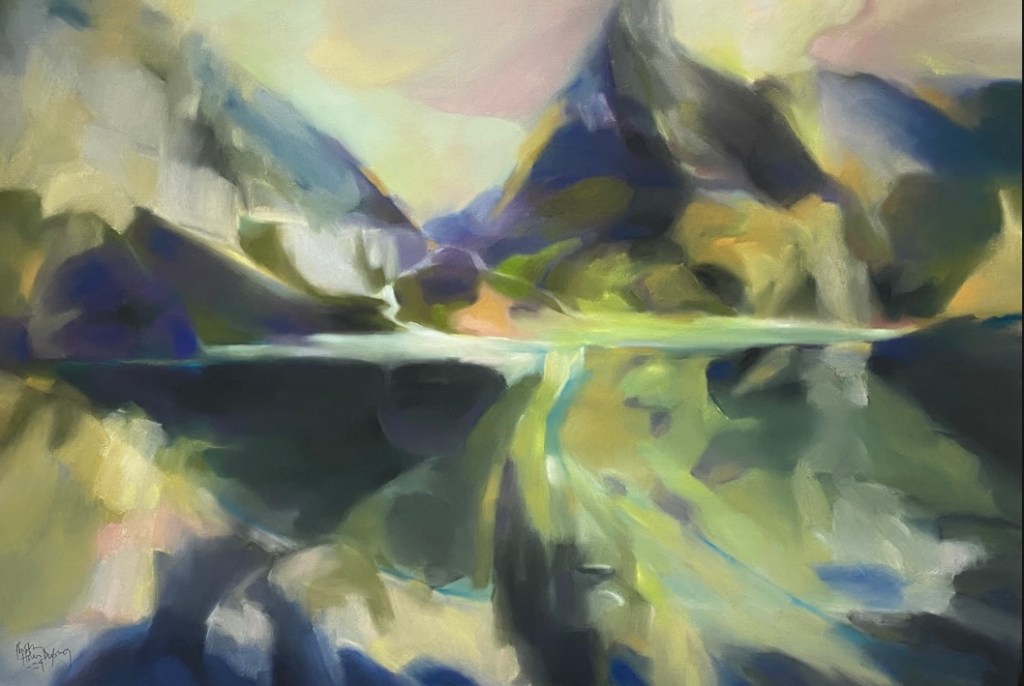
Her works move through water, shadow, memory, mountains and atmosphere. They are connected to the West coast of Norway, to the North Sea and to the fjords, but they do not function as simple landscape representations. Rather, they appear as emotional environments, places where perception, recollection and natural forces become inseparable.
In her pastel works, water is not only a subject. It is movement, memory, breath, danger, distance, transition and return. Light does not simply illuminate the landscape. It opens and conceals, reveals and protects. The image often seems to emerge from an intermediate space, somewhere between observation and forgetting.
For Nordrom Kunst, this conversation with Kristin Holm Dybvig became an opportunity to think about landscape not as a view, but as a living field of memory, sensation and transformation.
Nordrom Kunst
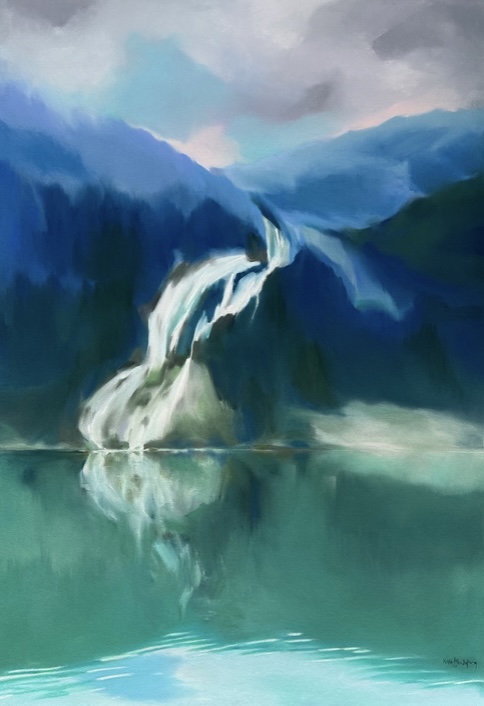
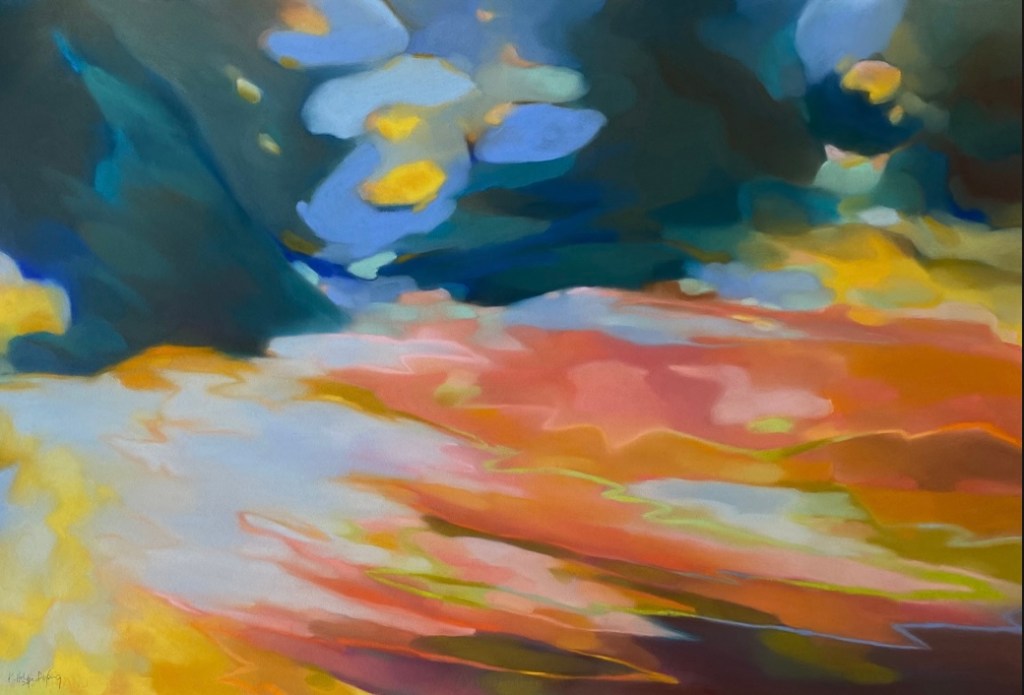
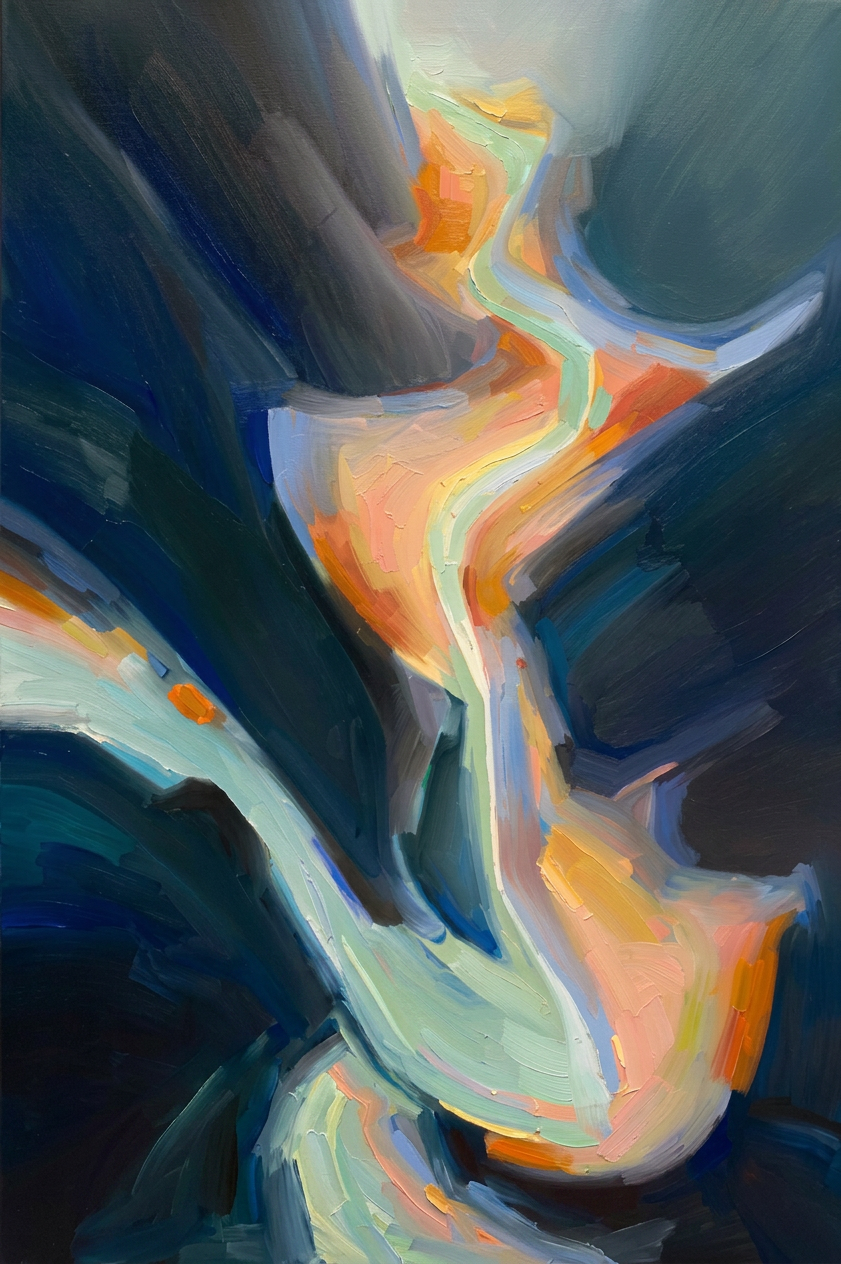
Your works often seem to move between landscape, atmosphere and inner perception. In works such as Falling Water, Revisiting Tide Pools on Rippling Shores and Beyond Moments and Memories, water and light appear to become more than natural elements. They feel almost like emotional or mnemonic spaces. How do these elements enter your work, and what role do they play in your artistic process?
Kristin Holm Dybvig
For me, water and light are not only external phenomena. They are part of the experience of being within creation. They act as passages between the physical landscape and inner perception.
Water opens the landscape. It creates breathing space, distance and perspective. It reflects the sky and, in a way, brings the heavens down to earth. Although it is transparent, it contains thousands of colours. It is always moving, driven by the moon and gravity, shaped by wind, yet also following its own inner flow, as in the meandering forms of rivers.
Water can be stronger than stone. It exists in countless states: the ancient stillness of glaciers, the noise of waterfalls and rapids, the softness of mist, rain or snow. Its form changes the emotional experience of a place. The ocean gives us a horizon and hides what lies beyond it, creating longing or curiosity. A narrow, dark fjord may appear austere, but it can also offer shelter and safety. The sound of water can be gentle, almost intimate, or overwhelming and violent.
Water is metamorphosis. A small stream becomes a river, falls over an edge, turns into mist as it hits the rocks below. This cycle reminds me that rhythm, movement and life continue independently of human influence.
Light is equally important, but I am especially interested in shadow. Jun’ichirō Tanizaki’s In Praise of Shadows describes the aesthetic of shadows in interiors, but for me his words also speak to the experience of light and darkness in the landscape, and to the fertile space between them.
Darkness contains the unknown, but it also gives room for new life, concealment and imagination. Light can be stark and revealing. I find comfort in the intermediate space between light and darkness. It is there that the forgotten meets the unknown, and where the past converges with the present on the paper.
Light enters darkness like consciousness entering oblivion. To bring things to light is, in many ways, what I try to do. I use the qualities of light to evoke memories, and water to set those memories back into circulation.
Nordrom Kunst
You mentioned that JUV is different from the other works because it is anchored in a specific physical place, while the other pieces emerge more from the fluidity of memory. How do you experience the relationship between observation and memory in your practice? Do these two sources lead you to different kinds of images, gestures or atmospheres?
Kristin Holm Dybvig
I wonder if there is truly a tension between observation and memory. Memories are built upon observations, but they also contain moods, emotions, experiences and different phases of life.
Observation, for me, is cooler and more distanced. Even when all the senses are involved, an observation remains a form of registration. It is less processed, less transformed.
When a work is anchored mainly in observation, it often becomes more constructed. It can be correct, well composed and aesthetically refined, but it may also lose some of the personal quality that is essential to my practice. That personal element is what I am trying to explore and communicate. Whether the viewer can perceive this difference is an open question, but for me it remains central.
When I travel, I often take photographs. The phone is always close at hand. But when I return home, I rarely look at the images. The experience itself is what matters. Sometimes, however, I revisit photographs to search for a specific mood or sensation. This was the case with JUV.
I have visited Vøringsfossen many times. It is fascinating and phenomenal in every season. After one visit, I felt a strong need to express the intense pull of the depth. I experience vertigo there, a very physical sensation. Standing at the edge, I feel as if I am falling with the water, merging with the descent of the waterfall.
I wanted to explore that sensation on paper, but it was more difficult than I had expected. I used a photograph during the first stage of the work. The photograph suggested vertigo, but the image itself remained flat. The feeling had to be retrieved from within.
In that process, I felt that memory became almost frozen. By staying close to the photograph, I found it harder to keep the process fluid. Although I remembered the place vividly, translating the impression of depth was difficult. I felt partly locked inside the photographic image.
The process of JUV was therefore different from my other works, because I could not focus entirely on my internal experience at the beginning. But the final stage was similar. At some point, one has to let go, step back, and allow the motif on the paper to become independent, to find its own artistic value.
This raises questions for me. Did I succeed in what I wanted to do? Is JUV an exploration of vertigo, or is it simply an interpretation of a waterfall? Does it hold artistic value beyond being an abstracted landscape? Perhaps it communicates depth, but does it truly convey the physical sensation of vertigo?
A memory is often connected to a specific place, but it is anchored in feeling. Memories are revisited through what I think of as a veil of forgetting. This veil becomes an organic and highly effective form of abstraction.
A memory based image, such as Revisiting Tide Pools on Rippling Shores, will inevitably differ from a work where the focus is placed more directly on the physical elements of a landscape.
The technique may be similar. My hands rub pigments into the paper. But the immediacy and intensity are different. Working from memory through the hand creates a dense and personal experience. I can focus on the memory itself, using fragments of surrounding landscapes almost as a scenography.
These landscapes are part of me. They come from my inner terrain. They provide a safe framework for working with something as intangible as memory. I find it fascinating that the oldest memories are often the most abstract, while newer memories may still retain more of the literal landscape.
Nordrom Kunst
Your works have a strong connection to the West coast of Norway, the North Sea and the fjords, but they also seem to move beyond a purely geographical reading of landscape. Are you currently developing new works, exhibitions or research connected to these themes? Is there anything about your current or future artistic direction that you would like to share with Nordrom Kunst readers?
Kristin Holm Dybvig
I do not know if I will ever finish exploring water as a theme. For those of us who live on the coast, water is constantly present, both physically and psychologically. My inner landscape is deeply connected to it.
I am surrounded by vast beaches open to the North Sea, deep fjords and mountain plateaus crossed by waterways. Water is a lifeline. It is connected to travel, longing, labour and opportunity. It has shaped coastal culture for as long as people have lived here.
I feel a profound connection to these landscapes. They connect me to those who came before me, to my family, and to a way of life lived both in harmony with and in struggle against the elements.
Many memories are tied to water. As a child, I remember having to row across the sound to reach the shop. In good weather, during summer holidays, this crossing could feel like an adventure. But for others, crossings like this ended in tragedy, with loved ones lost in rough seas.
My Vadested, or Crossing, series is based on these kinds of passages, both on foot and by boat. In these works, I try to capture the suspended moment when one stands safely on the shore, knowing that one must cross, just before taking the first step. There are more such moments of longing, more thresholds between one side and another, that still need to be told.
This connection to the past is important to me, not only within my own lifetime, but across generations. It also brings the future into focus. Not only my own future, but the future of those who come after us.
Underneath this is a fundamental respect for all living things. It is tragic that humanity has claimed ownership of the earth, exploiting it, profiting from it, and taking for granted the power to decide over life and death. We often lack understanding, empathy and respect. We have not been good stewards.
In my artistic practice, I try to offer a response that reflects respect for nature. All living beings share and depend on the same earth. My pastel paintings are entirely without human traces. They are reduced to sky, mountain and water. They show a reality that might have existed one hundred years before my time, but perhaps not after. I want to show what we are in the process of losing.
Recently, I have also begun a new series where I introduce animals into the landscapes, specifically sleeping animals. This creates another kind of quietness. A herd of deer exists in harmonic coexistence with its surroundings, as a quiet counterpoint to our restless human lives.
This is still a developing body of work. I do not know how long it will continue before the sea calls me back, but for now it allows me to continue exploring stillness and our relationship with the natural world.
Final editorial thoughts:
Through Kristin Holm Dybvig’s work, landscape becomes more than a place to be seen. It becomes a space of return, a field where memory, perception, shadow and movement continue to act.
Her pastel works do not describe nature from a distance. They seem to emerge from within it, from the body’s memory of water, from the pressure of light, from the silence before crossing, from the fragile threshold between what is remembered and what is disappearing.
For Nordrom Kunst, this conversation opens a quiet but urgent reflection on how landscape can still carry emotional knowledge, and how contemporary art can make visible what ordinary looking often leaves behind.
For more information about the artist please check her website: https://www.kristinholmdybvig.com
Instagram: https://www.instagram.com/kristinholmdybvig/
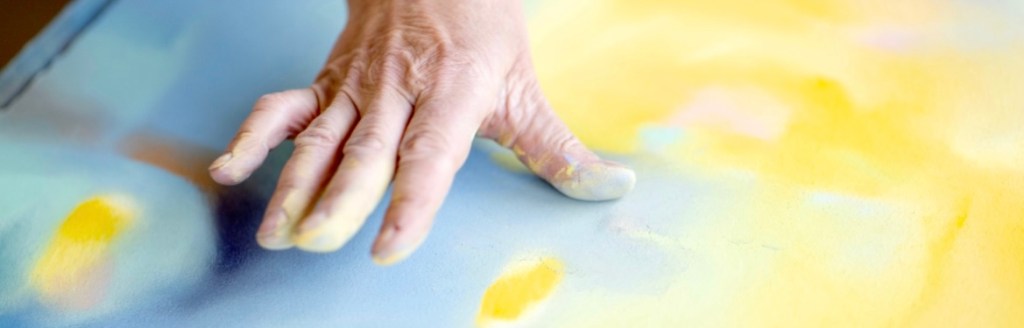
- Cover image: detail of Kristin Holm Dybvig’s hand. Photo by Marie Von Krogh. Courtesy of the artist.
 Nordrom Kunst
Leave a comment