
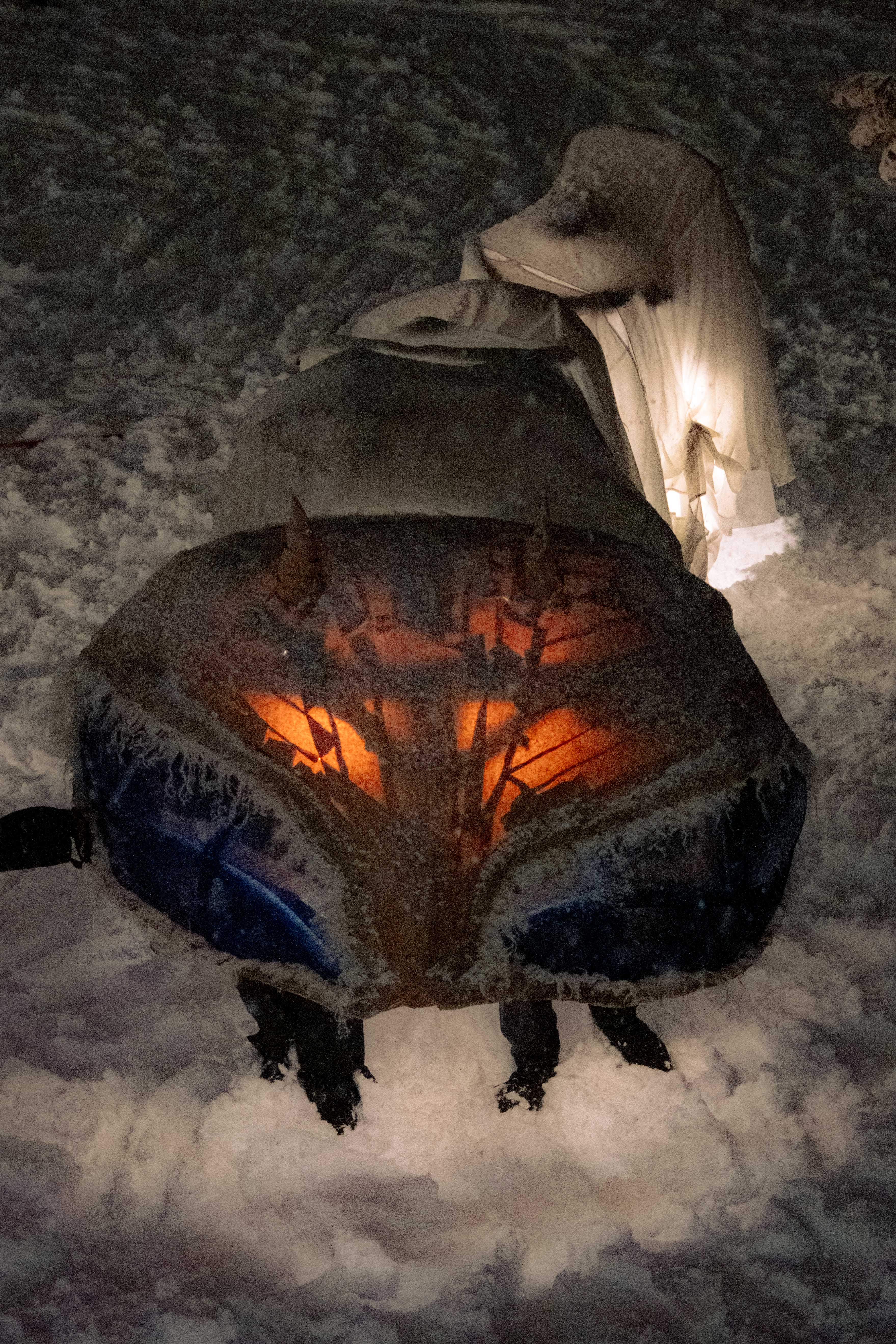
Working across textile, film and performance, Swedish-Norwegian artist Sirin Sponga creates worlds inhabited by fragile, solitary and often enigmatic characters. Drawing from traditional textile practices, animal encounters and slow material processes, her work explores alternative forms of knowledge that exist beyond language and rational explanation.
Inspired by the tactile histories embedded in wool, embodied experience and the possibility of communication beyond words, Sponga’s practice unfolds through close attention to atmosphere. Rather than offering fixed narratives or clear conclusions, her films, performances and installations open spaces where uncertainty, sensory experience and silent forms of understanding can emerge.
In this conversation with Nordrom Kunst, Sponga reflects on the search for spaces free from expectations, the communal and material histories carried by wool, and the complex relationship between slowness, perception and contemporary life.
Nordrom Kunst
Your work often creates spaces where people can simply exist, without having to perform or explain themselves. Where do you think this interest comes from, and what keeps bringing you back to it?
What happens when we do not have to explain ourselves, and our surroundings? When we can exist in spaces that are free from expectations. Maybe certain human, or not even human, more so animal qualities become more present. Breathing, feeling, hearing, smelling.
The conditions needed for creating a space without expectation are very different depending on who you are, where you feel safe. Personally I often experience it when meeting animals, certain people, or just by being outside. Often the occurrence happens without language.
That is why these rooms, or these experiences, are interesting for me to explore through film and installation. Both being some sort of communication that does not rely on language. But rather opens for more silent, roomly, or even unnatural atmospheres.
When you remove the language, or at least, the need to explain everything, you also make room for something else. This way of experiencing, or gaining knowledge, without language or statistics is arguably something we share with many other animals. Some people call it tacit knowledge (silent knowledge in Swedish).
When making the film entomologen (2026) I explored these different ways of gaining knowledge by introducing an entomologist studying invasive species to a talking insect. Allowing the perspective of the one who studies, and the one who is being studied to merge and clash.
There are no real conclusions, but by shifting between different ways of trying to understand the world opens up for new ways to relate to the landscape, and each other. I think that my films explore characters that try to find a way to understand the world, and often fail. They are a bit desperate. And a bit delusional. And they reach out to supernatural experiences to try to find meaning in something that does not make sense.

Nordrom Kunst
Wool appears in different forms throughout your work. I’m curious, what is it about this material that keeps you coming back to it?
Wool has an inherent history. It had its own life, on a sheep, and it is connected to the human traditions of handling the sheep. The material is natural, sustainable, durable, and humans have utilized it for thousands of years. Both for practical reasons, housebuilding, clothing, isolation, as well as for expression and identity. For me, working with wool has been a meaningful method to get in contact with family, and places to source and learn. I have been in contact with farms in Sweden (Kappeled), Norway (Tromsø & Unstad), and Iceland (Hradastadir). The process of learning to work with wool has been communal, it allows me to take part in a long tradition. And then, also, allowing me to feel a little bit free when I choose to break some of the traditions I learn.
The wool has to be washed, carded, (potentially dyed), and in my case, I often end up wet-felting. A physical process that is a lot about touching with the hands. For me the wool feels alive, and even when exhibited in gallery spaces, I experience that people walk up and touch it.
The act of creating something, is for me, an unpredictable experiment that focuses on the process more than the need to make a certain object. I am interested in the realisation of my own fantasy that happens when I start to put it into my physical world. Small signs that appear. Moments when people enter my workspace and try on a costume. All of a sudden they are in some sort of character. Making new movements or sounds, as a game, bringing whatever is being made to life. To then, take it off, and leave the costume.
It is small.
This strange mood that occurs when these objects and costumes are created.


Nordrom Kunst
You often speak about slow processes, experimentation and giving space to things that take time. In a world that seems to move faster every year, what does slowness mean to you today?
By demanding time there is room for new information. Information that comes forward without language, just by noticing details, or patterns. Slowness is present when working with wool because of the seasons. It is, for example, not very suitable to felt wool during the winter. Something I have attempted. The sheep are usually sheared twice a year, and therefore, limiting the window of time for picking up wool.
I think I romanticize slowness. The truth is that I live fast paced. I get bored easily. I have a phone, and I often try to do multiple things at the same time. But maybe that is why slow processes are interesting to me. It is something lacking, that I need more of.
Slowness can be a way to experience. The process of creating a textile. Or getting to know a place. Or a person. Or noticing details. Slowness can also be provocating, boring, and annoying. Slowness is a sort of register that allows more space and attention to notice yourself and your surroundings, both good and bad.


Cover image: Entomologen, 2026 – Documentation of performance – Mørketidsutstillinga, Kabelvåg, Norway (photo, Marie Bentzon)
For more information visit the artist website sinringsponga.com