As the future of one of Tromsø’s oldest cultural buildings is once again being discussed, its history raises a larger question: what should a city preserve when preserving the building itself is not enough?
The question of whether to sell all or part of Muségata 2 — the yellow brick building in the city’s south end that has housed Tromsø Kunstforening since 1981 — is expected to return to the municipal political agenda, although at the time of writing the case had not yet formally been submitted for consideration by the formannskap (executive board). As Kunstkritikk reported on 16 September, the art association’s leadership is worried, the municipality’s finances are strained, and the building itself has stood empty for years, waiting on a renovation whose costs keep growing. None of this is new. Muségata 2 has been the subject of sale discussions, in one form or another, since 2019. What is new, this time, is the context: a municipality newly placed under state financial oversight, a national government drafting the country’s first strategy for cultural venues, and a building whose case, as it turns out, sits at the intersection of both.
This is not a rewrite of that reporting. It is an attempt to look at the building itself: what it has represented for Tromsø since 1894, what the recurring uncertainty over its future says about how the city plans for culture, and whether there is a way to think about what Muségata 2 could still become that does not depend on either selling it or simply preserving it as it is.
Memory
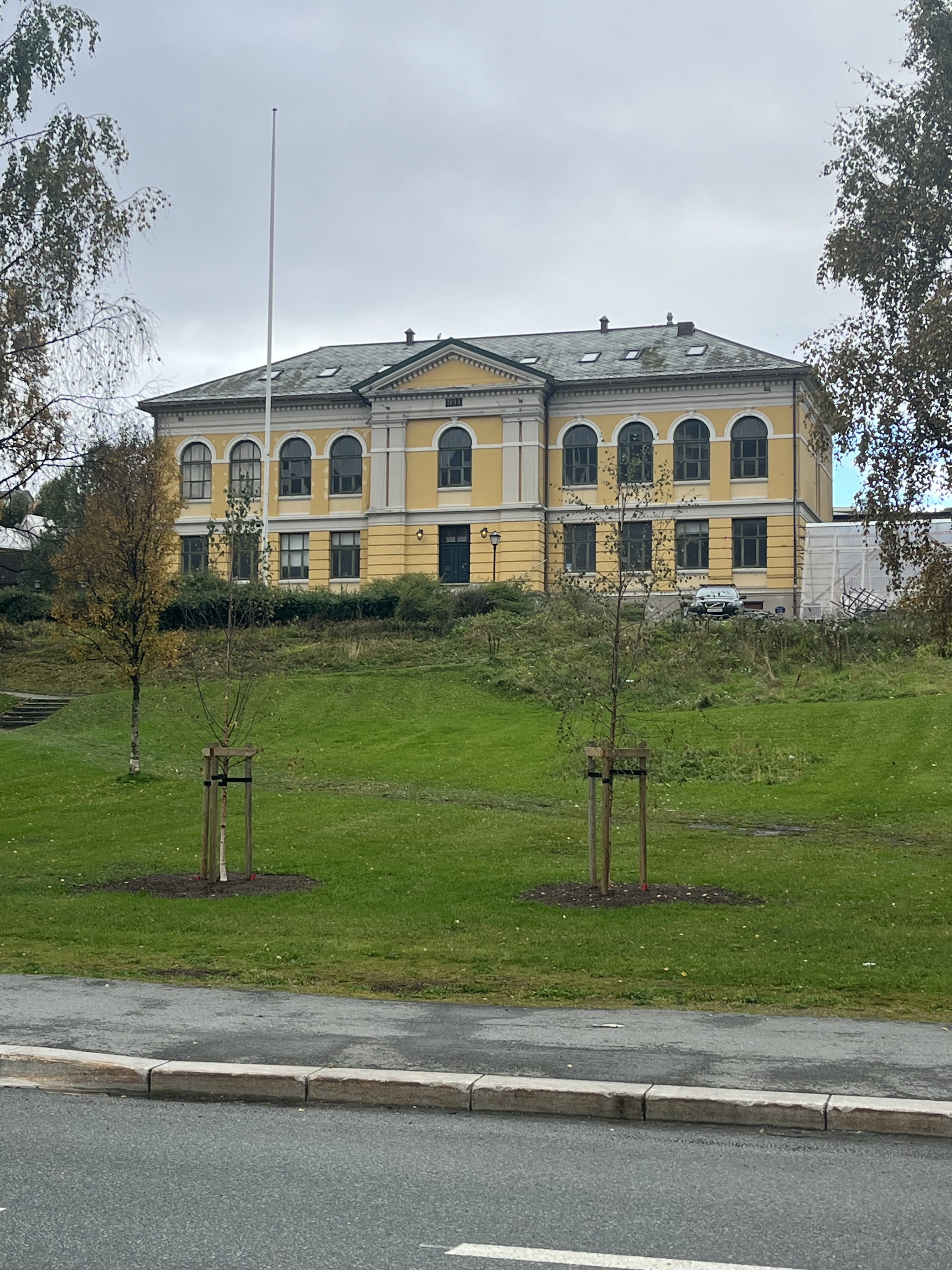
Designed by architect Lars Solberg in the early 1890s, the building was completed for Tromsø Museum in connection with Tromsø’s centenary celebrations in 1894 and formally inaugurated as the museum’s new home in 1895. The building’s restrained neoclassical style features a symmetrical brick facade, a central risalit, and generous ceiling height and window openings suited to displaying collections. Tromsø Museum, founded in 1872, had until then rented rooms elsewhere in the city; the new building gave it, for the first time, a purpose-built home. The museum used the building until 1961, when it moved to the site south on Tromsøya it still occupies today as part of what is now the Arctic University Museum of Norway.

What happened next is central to how the building is understood in Tromsø today. Rather than standing empty, Muségata 2 was occupied by the artist couple Idar and Eka Ingebrigtsen, who are widely credited with saving it from demolition and turning it into a self-organised cultural house, with studio space for artists, rehearsal rooms for musicians, and stages for theatre groups. Tromsø Kunstforening’s own account of this period, given by former intendant Leif Magne Tangen, describes the Ingebrigtsens turning the vacated museum into exactly this kind of multi-use culture centre, decades before the term “kunstens hus” was applied to it. The couple later lived in the neighbouring building at Muségata 4, which was also owned by Stiftelsen Tromsø Kunstsenter and transferred to Tromsø Municipality in 2019 together with Muségata 2. Plans to use Muségata 4 for artist studios, a guest apartment and children’s workshops were part of the proposed Kunstens Hus project and were never realised; the municipality sold Muségata 4 on the private market in 2025.


The park in front of the building, Muségata, carries its own, older layer of history. According to NRK Kvääni, Muségata is an extension of Finngamsletta, a heritage area where Sámi and Kven people used to live. That history has resurfaced in recent artistic work made in and around the building. Since 2021, Tromsø Kunstforening has run Goahtegieddi – Finngamsletta, a long-term outdoor project developed in collaboration with local artists Hilde Hauan Johnsen, Joar Nango and Kåre Aleksander Grundvåg, exploring how Muséparken can become a place for use, activity and practical knowledge-sharing, with attention to biodiversity and the Sámi and Kven histories of the area. Kittiwake hotels and the 2023 exhibition “I love Seagulls! An exhibition about living together” formed its first stage. Tromsø Kunstforening’s 2025 jubilee exhibition Historien er drømmen om det som kan bli continued this work with Vuoššangoahti / Kokegamma, made by Joar Nango and Eystein Talleraas of Vuogas studio together with craftsman Arne-Terje Sæther and artist Marit Bockelie, addressing Muséparken directly and drawing on Sámi building traditions. It is not a marginal detail. Any conversation about what this site is “worth” has to reckon with the fact that its cultural layers predate the museum building itself.
Tromsø Kunstforening, founded in 1924, had moved between several addresses in the city before it moved into Muségata 2 in 1981, carrying out an extensive renovation and adaptation of the building itself, with financial support from Tromsø kommune and Norsk Kulturråd. From 1988, the building also housed Nordnorsk Kunstmuseum, which opened to the public in rented rooms above the art association before moving to its current premises at Sjøgata 1 in 2002. For a decade and a half, in other words, Muségata 2 was simultaneously home to the region’s contemporary art association and its art museum. Ownership of the property itself passed through Stiftelsen Tromsø Kunstsenter. Camilla Fagerli, artistic and managing director of Tromsø Kunstforening, tells Nordrom Kunst that the foundation was established by Tromsø kommune and Tromsø Kunstforening in connection with TKF’s move into the building, with the purpose of giving the art association a permanent home while also providing space for other arts organisations whose activities could coexist with it. Two of its three board members were elected by TKF’s general assembly and one was appointed by the municipality; run voluntarily, the foundation did not, Fagerli says, have sufficient resources to finance the buildings’ substantial maintenance needs. Tromsø Kunstforening had — and still has — a fully subsidised rental agreement with the foundation, which according to Fagerli amounted to a form of indirect municipal support, giving the institution long-term premises without the cost of commercial rent; when Tromsø kommune took over ownership of the property in 2019 as the foundation was dissolved, she explains, that support effectively became direct, since the municipality became both owner and landlord. According to TKF, the 2019 agreement to dissolve the foundation and transfer Muségata 2 and 4 to the municipality was intended to establish conditions that would allow the buildings to be properly maintained while securing Muségata 2 as TKF’s home.

Crisis

The first serious threat to this arrangement came in 2019. Municipal case documents revealed that Tromsø kommune intended to sell Muségata 2, together with Muségata 4, to UiT – the Arctic University of Norway, for 13 million kroner. Tromsø Kunstforening’s board called the deal “a robbery in broad daylight” and accused the municipality of putting the city’s art scene at risk. Then-mayor Gunnar Wilhelmsen told Kunstkritikk it was important the municipality not sell away “this important legacy,” while also noting that the city’s art scene needed premises and that Muségata 2 was one of the few alternatives available for that kind of activity. The same reporting cited an estimated maintenance backlog of at least 19.3 million kroner: damp and mould damage in the basement, rot in the roof, sanitary, sprinkler and electrical systems in need of replacement, and a risk of asbestos and other environmentally hazardous materials. The formannskap’s decision was postponed more than once through 2019 and into 2020, and the sale to UiT was ultimately not carried through.
What followed was not a return to the status quo but an attempt to plan the building’s future more deliberately. In February 2021, Tromsø Kunstforening’s then-intendant Leif Magne Tangen, KiT (Kunstnerne i Tromsø) leader Henrik Sørlid, mayor Gunnar Wilhelmsen and TKF board chair Kolbjørn Engeseth presented the idea of a “Kunstens Hus” (House of Art) in Muségata 2: a full renovation, estimated at the time at around 20 million kroner, intended to add exhibition space, artist studios, a shared workshop, and public meeting spaces such as a café. The formannskap voted in May 2021 to proceed with the concept, and Tromsø Kunstforening adopted a 2021–2024 strategy plan built around it. In autumn 2022, the municipality launched a sketch project covering renovation options for both Muségata 2 and Muségata 4, alongside plans for a shared concept for performing arts in the city; a related side-project addressed how to protect the building’s facades from nesting kittiwakes, whose droppings had accelerated the building’s decay.
That plan is the direct predecessor of the situation described in this month’s reporting. Renovation work did eventually begin: drainage work around the building was completed, but costs rose beyond initial estimates, and Tromsø Kunstforening moved temporarily to the former Hvilhaug care home in 2023, alongside the artist studio collective Loftet Arbeidsfellesskap, expecting to be there for roughly a year and a half. Three years later, the association is still there — a temporary relocation tied to the building’s renovation, Fagerli says, not the end of TKF’s relationship with Muségata 2, which it has regarded as its permanent home since 1981. According to Kunstkritikk, the municipality has since begun exploring both an outright sale and possible forms of divided ownership or co-use with UiT, and a new valuation and cost estimate are underway. Fagerli tells Nordrom Kunst that TKF has not yet been presented with a concrete model or detailed information about UiT’s intended use of the property, and that what is currently being prepared concerns whether Tromsø Municipality wishes to proceed with the possibility of selling all or part of Muségata 2 and Muséparken — not a decision already taken. Fagerli told Kunstkritikk that reopening the question of where the institution will exist takes time and capacity that would otherwise go into programme and outreach.
The renewed uncertainty coincides with a harder financial reality for the municipality itself. Following repeated budget overruns, Tromsø kommune now carries a deficit in the hundreds of millions of kroner and close to 13 billion kroner in debt, and entered the state’s ROBEK register on 26 August 2026, placing its budget, borrowing and certain long-term financial commitments under additional state oversight. When Kunstkritikk asked the municipality whether the potential sale of Muségata 2 is linked to this broader financial situation, it received no answer. Thomas Birkeland, who leads the municipal committee responsible for environment, sport, culture and community development, said the case had not yet formally been put on the agenda and could only be commented on once the case papers, including the assessment and recommendation, were available ahead of the formannskap meeting.
Fagerli’s response has been to argue that the municipality should, before any sale is decided, examine what a new national strategy for cultural venues might offer. The kulturarenastrategien was announced by Culture and Equality Minister Lubna Jaffery in February 2026, building on the earlier cultural-volunteering strategy “Rom for deltaking” and the 2025 NOU report “Musikklandet.” The government intends to present the strategy in the winter of 2027, and its stated themes include better use and upgrading of existing buildings, more predictable financing, and clearer cooperation between the state, county authorities and municipalities. The deadline for written input is 1 October 2026, shortly after the case had been expected to return to the formannskap’s agenda, although, as noted above, no formal submission had been confirmed at the time of writing. Fagerli wants Tromsø kommune to use that window to put its own case on the table, rather than treat the sale purely as a property transaction.
There is a documented tension underneath that argument. Tromsø’s own knowledge base for its cultural plan, the Kommunedelplan for kultur 2024–2031, is intended to fulfil the purpose of Norway’s new Kulturloven, in force since July 2025, which frames art and culture institutions as part of the democratic infrastructure the state and municipalities are responsible for sustaining. Commentary on the case, including a recent opinion piece by Tromsø Kunstforening published in iTromsø and Nordnorsk debatt, points out that the plan’s own knowledge base identifies a significant need for spaces for the cultural sector, for both production and presentation, and names Muségata 2 as one of the venues the municipality already counts among its cultural infrastructure, with the upgrading of existing cultural premises framed there as a genuine alternative to new construction. Whether or not that tension is resolved when the case returns to the political agenda, it means the sale cannot be assessed as a property transaction alone, without reference to the municipality’s own stated cultural planning goals.
It is worth being precise about what is, and is not, established about the building’s legal status. In 2019, art sociologist and former Tromsø Kunstforening intendant Dag Solhjell asked the Directorate for Cultural Heritage (Riksantikvaren) to formally list (“frede”) the old Tromsø Museum building as an exhibition space. Fagerli confirms that Muségata 2 is not formally fredet by Riksantikvaren, but is vernet under Tromsø’s municipal planning framework under the Planning and Building Act. The municipal heritage map identifies the property with Vernekode 1 and within Hensynssone H570.
It is also worth separating this case from Tromsø’s other major cultural infrastructure project. The Kulturkvartalet, a planned building on the site of the former Mack brewery, would co-locate Arktisk Filharmoni and Nordnorsk Kunstmuseum with the municipality in a new, roughly 17,000-square-metre building designed by Nordic Office of Architecture with ALA Architects. It is currently in a pre-project phase, with an estimated investment cost of 1.05 billion kroner, financed mainly by the state, and construction could start at the earliest in the first quarter of 2028. Kulturkvartalet does not include Muségata 2 or Tromsø Kunstforening, and it is aimed at different institutions with different scales of operation. Any proposal for Muségata 2’s future needs to be legible against that backdrop, not read as a smaller version of the same thing.
Existing national funding mechanisms also complicate the idea that the only choices are municipal ownership or a private sale. Kulturdirektoratet’s ARENA scheme supports building and infrastructure projects for the professional, project-based arts field, including renovation, pre-projects and feasibility studies. The Nasjonale kulturbygg scheme, administered by the Ministry of Culture and Equality, offers investment grants, typically up to a third of eligible costs, to museums and cultural institutions with a national, nationwide or significant regional function. Neither scheme is cited here to suggest that Muségata 2 automatically qualifies for either; only to note that Norwegian cultural infrastructure is financed through a range of models involving different levels of government, and that this is one of the things the pending national strategy is explicitly meant to map.
Possibility
None of this history settles the question of what Muségata 2 is worth to Tromsø today. Preserving a building physically is not necessarily the same thing as preserving its cultural function, and the building’s own history makes that distinction hard to avoid. Muségata 2 has already accommodated different cultural actors and functions over time: museum, occupied culture house, and — for a decade and a half — the shared home of an art museum and an art association. But its history is not simply a sequence of uses succeeding one another. Fagerli clarifies that Tromsø Kunstforening has regarded Muségata 2 as its permanent home since 1981, and that TKF’s move to Hvilhaug in 2023 is a temporary relocation tied to the building’s renovation, not the end of that relationship. What emerges is less a single unbroken use than a tension between adaptation and continuity: the building has repeatedly changed to accommodate new cultural needs, while Tromsø Kunstforening represents a significant institutional continuity within it since 1981.
That pattern suggests one way of asking the question differently. Rather than treating the “Kunstens Hus” concept from 2021–2022 as either achieved or abandoned, it may be worth asking whether Muségata 2 could keep Tromsø Kunstforening as an independent artistic core while developing a broader, more experimental public function: a place where Tromsø investigates its own transformation as a city in the European Arctic. Tromsø Kunstforening’s Goahtegieddi – Finngamsletta project, including Joar Nango’s contribution to the 2025 anniversary exhibition, already points in this direction, treating the site’s Sámi and Kven history as material for contemporary art rather than as a historical footnote. A future Muségata 2 could plausibly extend that kind of work: a space where questions of urban development, tourism and everyday life, cultural infrastructure, ecological change, and the representation of Sámi and Kven histories are addressed through exhibitions, research collaborations, and public discussion, alongside continued exhibition programming.
This is an editorial proposition, not a plan, and certainly not one Nordrom Kunst is in a position to put forward on Tromsø’s behalf. It is also not a claim that Tromsø currently lacks these things; that would need its own evidence, and this article has not gathered it. That collective thinking, however, is not a new proposition. In 2020, Tromsø municipality initiated a process to examine the future use and artistic content of Muségata 2 as part of the Kunstens Hus project. A working group involving Tromsø Kunstforening, artists, cultural actors and municipal representatives met throughout the autumn, alongside a public meeting and workshop. Its recommendations envisioned Muségata 2 as a shared centre for contemporary art, artistic production and public encounter, with a rehabilitation project proposed for 2021–22. Seen from 2026, the question is therefore not simply whether such a collective process could take place, but what became of the work that already did. As the municipality once again considers the building’s future, the 2020 process provides an important part of the history against which the present debate can be understood. Fagerli’s own comments suggest one reason to take that question seriously. She stresses that TKF’s position is not that cooperation or coexistence with UiT should be ruled out; rather, TKF has asked for a joint process involving Tromsø Kunstforening, UiT and Tromsø kommune to examine how such an arrangement could actually work before any decision is made. According to TKF, the central question is not simply who owns Muségata 2: municipal ownership, together with the fully subsidised rental agreement described above, has formed part of the public support structure under which TKF has been able to operate independently. What TKF wants, Fagerli says, is clarity about how its existing rental agreement, institutional autonomy and long-term conditions in Muségata 2 would be secured under any new ownership or co-ownership arrangement — a concern that is TKF’s own, and one this article does not attempt to resolve. Tromsø Kunstforening itself, meanwhile, is not the voluntarily run body it is sometimes taken to be: Fagerli describes it as an independent, professionally run art institution and democratic membership organisation with paid professional staff, whose elected board serves voluntarily and which has historically relied in part on voluntary contributions from members. Any future for Muségata 2 that keeps Tromsø Kunstforening at its centre would need to answer TKF’s stated concern directly, not around it.
What remains
Muségata 2 has never been static. It was a museum for under seventy years, an occupied culture house for two decades, and a shared home for an art museum and an art association for over a decade after that. But its history is not simply one of successive uses each giving way to the next: Tromsø Kunstforening has occupied the building continuously since 1981, through the years it shared it with Nordnorsk Kunstmuseum and through its current, temporary absence during renovation. What Muségata 2 is worth to Tromsø today, in other words, is not reducible to the building alone. It is the physical structure; its layered cultural history, from the 1894 exhibition to Goahtegieddi – Finngamsletta; Tromsø Kunstforening’s institutional continuity within it; the public support structure — ownership and subsidised rent alike — that has sustained that continuity; Muséparken and its evolving cultural role; and the open possibility that ownership, use and institutional responsibility could all change in the years ahead. Whatever the formannskap eventually decides, weighing all of that is probably a better guide to what the building is worth than either its market value or a general appeal to keep old buildings standing simply because they are old.
Update, 18 September 2026: This article has been updated following detailed clarifications provided directly to Nordrom Kunst by Camilla Fagerli, artistic and managing director of Tromsø Kunstforening. The revisions clarify the institutional history of Muségata 2, the role of Stiftelsen Tromsø Kunstsenter, TKF’s current relationship to the building, the status of Muségata 4, and the present municipal process.
Editor’s note, 18 September 2026: Following publication, Tromsø Kunstforening provided Nordrom Kunst with the December 2020 report Om bruk og kunstnerisk innhold i Muségata 2, documenting the earlier Kunstens hus process. The article has been updated to incorporate this additional primary source.
Fabio Lanna