WATER, MEMORY AND TRANSFORMATION
An interview by Nordrom Kunst
I first encountered Ylva Sahlström’s work at Kurant in Tromsø, during the opening of the end of year graduation exhibition The Sound of Bells and Dogs Barking. I was immediately drawn to her artistic research and to the way materials within her work appeared to exist in a continuous state of transformation.
Water, ice, natural pigments and metal recur throughout the works presented here. They melt, disperse, oxidise, evaporate and leave traces. Through these processes, Sahlström explores transformation, memory, loss and impermanence, alongside the relationships between bodies, materials and landscapes.
That first encounter at Kurant became the starting point for this conversation. Nordrom Kunst invited Sahlström to reflect on water and ice within her practice, on material agency and authorship, and on how living and working in Tromsø has influenced her understanding of landscape, time and transformation.

Your recent work seems to approach water and ice not only as natural elements, but as materials that carry time, memory and bodily relation. In Drick värmen ur min hand, water connects body, place and those who came before and after us, while Tracing Ice, Melting Time appears to continue this attention to transformation and temporal processes. How do you understand water and ice within your practice, as material, metaphor, process, or something else?
Water has been a recurring presence throughout my practice, and ice is not separate from my earlier works but rather an extension of concerns that have been with me for a long time. I think of water and ice as containing all of the aspects you mention in your question: they are material, metaphor, process, memory and relation at the same time, while also having their own agency.
During my master’s studies, I worked extensively with Astrida Neimanis’ concept of hydrofeminism and her book Bodies of Water, which continues to resonate with me. I often return to her idea that understanding ourselves as bodies of water challenges the separation between humans and nature and invites us to think differently about time, space and our ethical responsibility toward other forms of life. Water is an urgent question, both now and into the future, and our relationship to it, or our distance from it, shapes the world we live in.
On a personal level, water has always carried strong emotional associations. It is closely connected to my mother, to a sense of contact with something larger than myself and to experiences of bodily presence. It is both intimate and expansive.
Drick värmen ur min hand emerged from an exhibition I developed last summer, where memory, time, embodiment and motherhood became central themes. The ice shell in the work was made from water collected from the lake in my home village, the same lake that provides the local drinking water.
It is a place that feels almost mythical to me. As children, we would secretly swim there even though we were not supposed to, because it is a protected water source. It is one of those Swedish inland lakes with soft, dark brown water. The lake is called Sjösjön, literally “Lake Lake”, and local stories say that it is as deep as two lakes stacked on top of one another. Many of the lakes in that region were formed by meteorite impacts.


The pigment in the ice comes from black hollyhock, one of my mother’s favourite flowers. Its deep purple colour is something I strongly associate with her.
There is something in the surface tension of water and in the slow melting of ice that speaks about letting something go. I think about memories, about the sadness of disappearance and about how things may never return in the same form, yet continue to exist as sensations or traces. Perhaps it is less grief than a kind of melancholy, a recognition that something has left and cannot come back, even though it remains present in another way.
For me, many of these experiences are bodily moments of transformation in life and in the body. In the publication accompanying the exhibition, I wrote about three memories connected to water: bathing with my mother and sisters as a child, the transition from childhood into adolescence and the experience of pregnancy loss. In all of them, water became a carrier of memory, change and embodied knowledge.
In Tracing Ice, Melting Time, the focus expands toward larger processes of transformation and loss. As you suggest, the work is concerned with temporal processes, but also with the traces left behind and the encounters between different materials and movements. What interests me is not only change itself, but the marks it leaves, the residue of a transformation that is still unfolding.
Both works are concerned with transformation, loss, renewal and what remains. They approach these questions through different forms and scales, but they share an interest in how bodies, memories, materials and landscapes are constantly moving through processes of becoming and letting go.
Many of your recent works seem to emerge through collaboration with natural processes rather than direct control. What have water, ice and other transforming materials taught you about letting go of authorship within your practice?
Working with water, ice, natural pigments and other transforming materials has made me more attentive to processes that exist beyond my control. Rather than imposing a fixed form, I often create conditions where materials can act and respond on their own terms. Water follows gravity, pigments spreads in different ways depending on the material, ice melts according to temperature and time.
In that sense, the work emerges through a collaboration between myself, the materials and the environment. This approach has taught me to embrace uncertainty and to see authorship as something more distributed. I am still making decisions. What interests me is the space between intention and material agency, where something unexpected can occur.

I think this relates to my broader interest in transformation, loss and impermanence. Just as memories change over time and landscapes are continuously shaped by water and weather, the materials I work with are always in the process of becoming something else.
Letting go of authorship is therefore less about stepping back entirely and more about listening closely to what the materials are doing and allowing their movements, rhythms and temporalities to become part of the work. We are constantly affecting and being affected by the world around us. Working with these materials makes that relationship tangible, as the form of the work emerges through an encounter rather than a single act of creation.
Your exhibition Tracing Ice, Melting Time was developed in Tromsø, a place where seasonal change and environmental transformation are deeply present. How has living and working in the Arctic influenced the way you think about time, materiality and landscape?
I believe we are shaped by the environments and landscapes we inhabit, and that inevitably finds its way into what we create. Following ideas such as those in Astrida Neimanis’ Bodies of Water, I do not see us as separate from our surroundings but as part of them. The landscape enters us through our senses and reappears, often intuitively, in my work.
There is something both monumental and existential about the landscape of Northern Norway. The sharp mountains, rapidly changing weather and shifts between darkness and continuous light create a heightened awareness of time and presence.
The spring is so short. All plants are growing from day to day, and you can really see it. It’s intense and you feel very much alive, in an almost manic way.
Glaciers became important in the research of ice for Tracing Ice, Melting Time. A conversation with a glaciologist at UiT changed how I thought about ice. The way she spoke about glaciers with its own names as living landscapes, each with its own movements, history, mineral composition and various microorganisms.

The loss connected to these vast bodies of ice and water has a enorm impact on so many living being and landscapes, it is difficult to fully grasp. I have always been fascinated by geology and by how water slowly shapes landscapes over time. In many ways, I see a parallel to our own bodies: bodies of water that are constantly changing. I am interested in melting not only as a physical process but also as a way of thinking about time and grief.
For me, grief can freeze us, keeping us suspended in a moment in time as we try to preserve something that has already changed. But eventually, it begins to melt, seep, leak and transform. It can also move like water, returning unexpectedly, changing form and leaving traces behind.
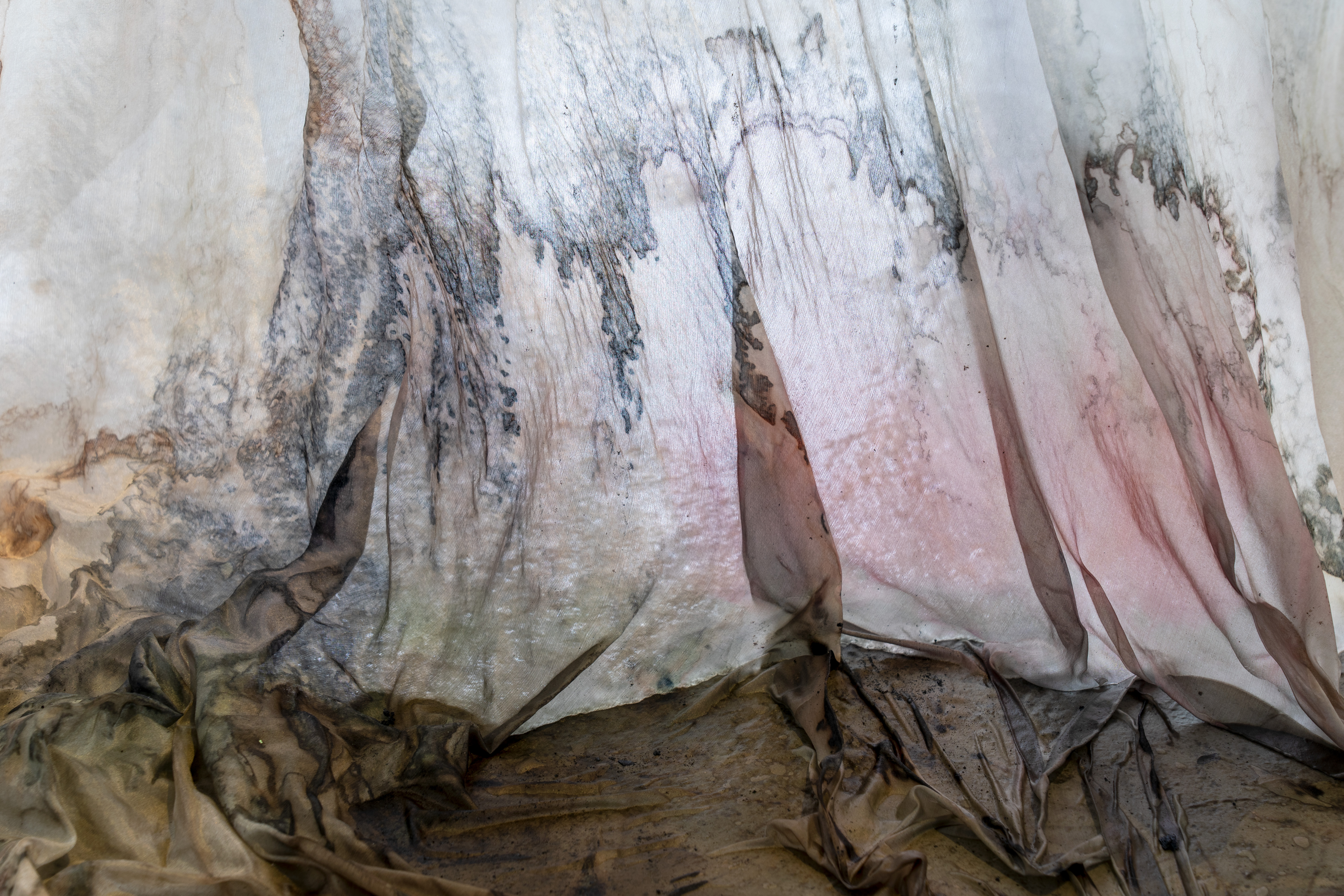
This idea runs through the work: ice and pigments become water, water moves through textile, gathers on metal and eventually evaporates, or seeps onto the floor, down into the floor drain and continues out into the sewer system, back into the circulation of water.
Many of your works remain in a state of transition, melting, leaking, oxidising or changing over time. What interests you about creating artworks that resist permanence and continue to evolve after they leave the studio?
I think my interest in materials that melt, leak, oxidise or transform over time comes from a broader fascination with impermanence and change. Very little in life is fixed, yet we often try to preserve things, memories, bodies, relationships or landscapes, as if they could remain unchanged.
My work often starts from an acceptance that transformation is inevitable. Working with materials such as water, ice, natural pigments and metal means that the artwork continues to evolve. I am interested in how these processes make time visible. A melting block of ice, a spreading pigment or the slow oxidation of metal leaves traces of its interaction with the surrounding environment. The work becomes a record of a relationship between materials, place and time.


I am also drawn to the tension between presence and disappearance. When ice melts or water evaporates, something is lost, but something else remains. A stain, a mineral deposit, a colour shift or a memory. In that sense, the works are about what persists through change.
Rather than seeing an artwork as a finished object, I often think of it as a living process. For me, the ongoing performance of the materials is also essential to the presence of the work and to the viewer’s experience.
The work exists in the present, in a continuous state of transformation. It unfolds as the ice melts, and even afterwards, as the water evaporates and what remains are traces of that process. The changing material itself becomes a kind of performer, making time and transformation tangible.
This relates to my interest in bodies, landscapes and water as interconnected systems that are constantly affecting and transforming one another. Allowing a work to continue changing after it leaves the studio acknowledges that it remains part of the world and its ongoing processes.

Ylva Sahlström is an artist whose practice explores material processes and relationships between bodies, memory and the natural environment. She completed her Master’s studies at the Kunstakademiet in Tromsø in 2026.
Artist website: ylvasahlstrom.se
Cover image: Ephyror, close up (2026), graduation show, The Sound of Bells and Dogs Barking, Kurant visningsrom. Photo: Anna Ida Annerskog.